

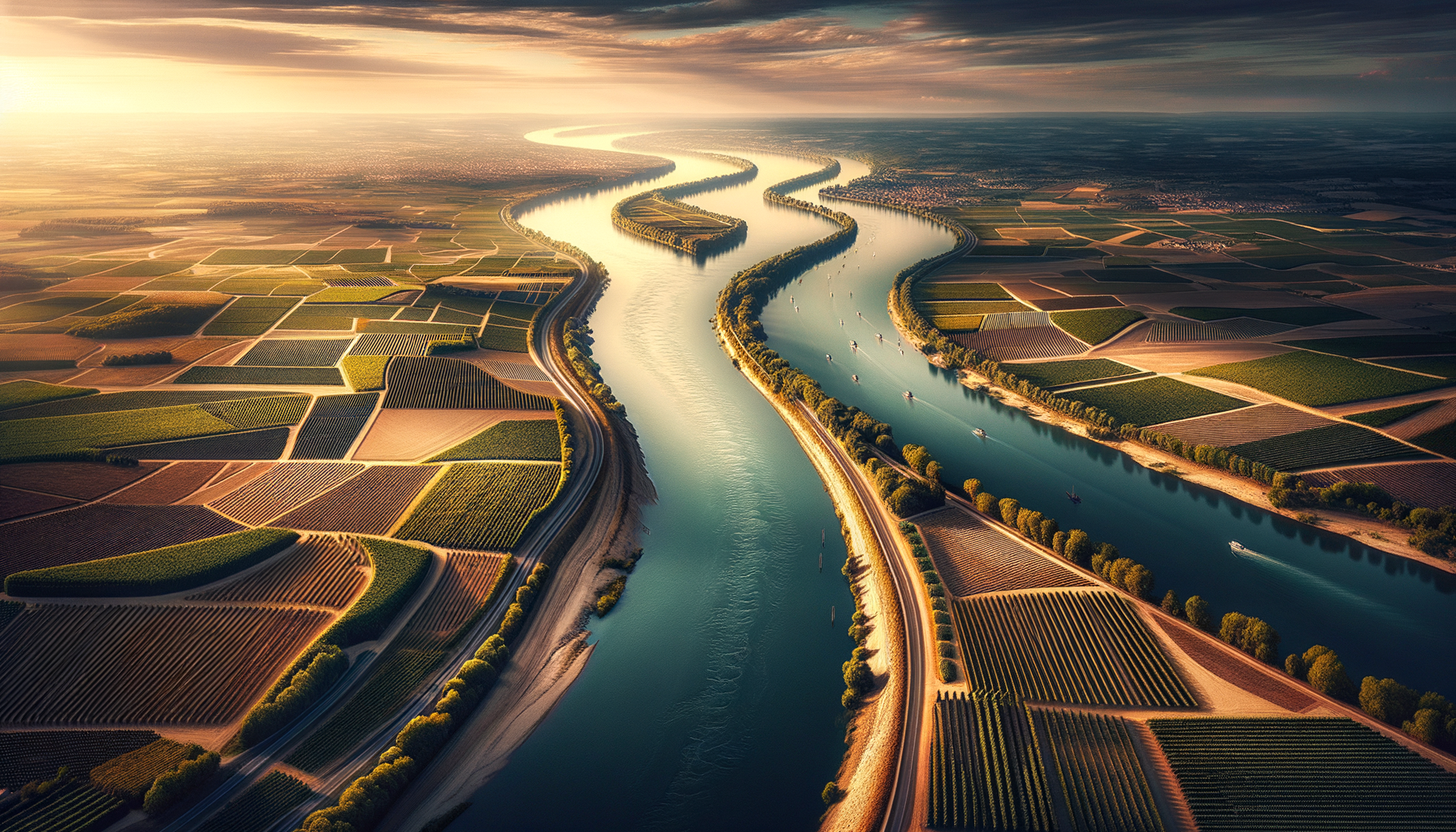
The Gironde divides Bordeaux into two worlds — the left and right banks with different soils, grape varieties, and histories. We explain in lively language why this matters in a glass.
If you've ever held a bottle of Bordeaux, you've almost certainly heard mysterious phrases like "left bank," "right bank," "Gironde." For locals, this is everyday geography, for sommeliers, it's the language of the profession, and for us, it's the key to understanding why two red wines from the same region can be so different.
Let's try to understand in plain language: what is the Gironde, how do its banks differ, what wine is made there, and how have the history of politics, trade, and even mosquitoes (!) influenced the taste of Bordeaux.
Gironde: not just a river on the map
Gironde is a large estuary, a wide delta where two rivers, the Garonne and the Dordogne, merge, and then this waterway flows into the Atlantic near Bordeaux. It is along the Gironde that one of the world's most famous wine regions, Bordeaux, has formed.
Bordeaux is not just a city, but an entire wine universe with thousands of estates (châteaux) and hundreds of appellations. Every year, over 700 million bottles of wine are produced here, ranging from rich reds to elegant whites and sweet wines. The central axis of this world is the Gironde, which literally divides the vineyards into two banks with different characters.
Left bank: the land of Cabernet and gravel
When people talk about the "left bank" of the Gironde, they mean the vineyards lying on the western side of the estuary and the Garonne. This primarily includes the famous zones of Médoc (with sub-zones like Margaux, Pauillac, Saint-Julien, etc.) and Graves.
What's in the soil
The key word here is gravel. The subsoil of the left bank is rich in gravel, sand, and limestone. Gravel retains heat well and drains excess moisture, which particularly suits the Cabernet Sauvignon variety.
- Gravel – better drainage, warmer soils, slower ripening.
- Limestone – minerality and structure.
What's in the glass
On the left bank, blends (mixes of varieties) are usually dominated by Cabernet Sauvignon. Merlot, Cabernet Franc, and sometimes Petit Verdot are added, but it is Cabernet that sets the tone.
- More restrained in aroma in their youth.
- More tannins (a sense of astringency), tougher in youth.
- Taste: blackcurrant, cedar, pencil, graphite, tobacco, dry herbs.
- Excellent aging potential – becoming velvety and deep over the years.
Left bank wines are often called the "classic face of Bordeaux" – they formed the legend thanks to the 1855 classification, created for the World Exhibition in Paris. At that time, the Gironde brokers' syndicate, commissioned by Napoleon III, divided the Médoc and Graves châteaux by "cru" – levels of prestige that remain relevant today.
Right bank: the soft character of Merlot
The "right bank" refers to the eastern side of the Gironde and the Dordogne. The most famous names here are Saint-Émilion and Pomerol, as well as smaller appellations around the town of Libourne.
Soils and climate
The right bank features more clay and limestone soils, cooler and wetter compared to the gravel hills of the left bank. These conditions particularly suit the Merlot variety.
- Clay – retains water, gives power and density to the wine.
- Limestone – adds freshness, a long aftertaste.
Wine style
On the right bank, blends are dominated by Merlot, with Cabernet Franc often playing the role of "aromatic partner."
- More tannins.
- Plum, cherry, sometimes chocolate notes.
- Wines often seem more accessible in their youth.
Interestingly, in the official 1855 classification, the right bank was practically not represented: Libourne did not have its own brokers' syndicate, so the right bank estates were not included in the list. Their fame is the result of a later history, in the 20th century.
Why the banks are so different: a bit of historical context
Romans, monks, and the English
Winemaking around Bordeaux began as early as the Romans in the 1st century AD. They introduced grapevines to Gaul and appreciated the mild maritime climate and the valleys of the Garonne and Dordogne as excellent places for vineyards.
In the Middle Ages, Bordeaux made a real leap thanks to politics. In the 12th century, after the marriage of Eleanor of Aquitaine to Henry Plantagenet, the lands of Aquitaine came under the control of the English crown. For the English, Bordeaux wine became a strategically important commodity: they massively imported "claret" – light red wines from the Garonne and Gironde, which made the region famous in Northern Europe.
Left bank: the path to London and hierarchy
Proximity to the Atlantic and a convenient exit via the Gironde made the left bank a trade corridor to England. Large estates developed here that could consistently supply large batches of wine. These are the ones that made it into the elite 1855 classification, which secured the left bank's status as the "aristocrat of Bordeaux."
Wine historians emphasize that the success of French wines was largely based on the combination of unique climatic conditions and savvy trade. In Bordeaux, this was particularly evident.
Right bank: slow start – loud success
The right bank remained somewhat in the shadows for a long time – more small estates, less direct access to major port routes. Its star moment came in the 20th century when the world was swept by a wave of enthusiasm for softer, "more human" red wines. Merlot from Saint-Émilion and Pomerol, with its juicy fruit-plum nature, fit perfectly into this trend.
Today, the right bank has its own classifications (especially in Saint-Émilion), and some Pomerol châteaux have become true cult brands – often without any official "cru" in the spirit of 1855, but with cosmic demand at auctions.
Not just red: white and sweet wines of the Gironde
Although Bordeaux is primarily associated with red wines (which make up the majority of those same 700+ million bottles a year), the region around the Gironde also produces very interesting white wines.
- On the left bank, in parts of Graves and Pessac-Léognan, dry whites are made based on Sauvignon Blanc and Sémillon.
- In the Sauternes area (upstream of the Garonne), legendary sweet wines are born, where mists created by the proximity of the river help develop "noble rot" botrytis.
Again, the role of water and microclimate is key: it is the combination of rivers, the Atlantic, and soils that creates the "Bordeaux terroir" that is so often talked about.
Interesting facts about the Gironde and Bordeaux
- The name of the local red wine gave rise to the word "Bordeaux" – that same deep red-brown color.
- French winemakers were among the first to massively store wine in oak barrels, which not only simplified transportation but also improved the taste of the drink.
- Phylloxera, a small bug from America, almost destroyed all of France's grapevines in the 19th century; Bordeaux vineyards were saved by grafting European varieties onto resistant American rootstocks.
- The region has about 9,000 châteaux and over 15,000 winegrowers – from small family farms to large estates.
- The inscription "Mis en bouteille au château" on the label means that the wine was bottled right at the estate where it was produced.
How to "taste" the Gironde in a glass
To feel the difference between the banks of the Gironde, you don't have to go to France (although it's always a good idea). Just take two bottles:
- Left bank – for example, an appellation from Médoc or Haut-Médoc, where Cabernet Sauvignon dominates the blend.
- Right bank – wine from Saint-Émilion or any appellation with "Côtes" near the Dordogne, where Merlot plays the leading role.
Try them side by side: pay attention to the aroma (blackcurrant and cedar versus plum and cherry), to the tannin sensation (drier, more structured left bank classic versus softer, "rounder" right bank texture). At this moment, the Gironde ceases to be just a line on the map – it becomes a taste boundary between two characters of one great region.
And perhaps next time, when you hear a sommelier say "this is a typical left bank," you'll know for sure that behind these words stand Romans, English kings, gravel soils, and Merlot ripened on a sunny clay slope above the Gironde.








Comments (0)
No comments yet. Be the first to comment!
Leave a Comment