

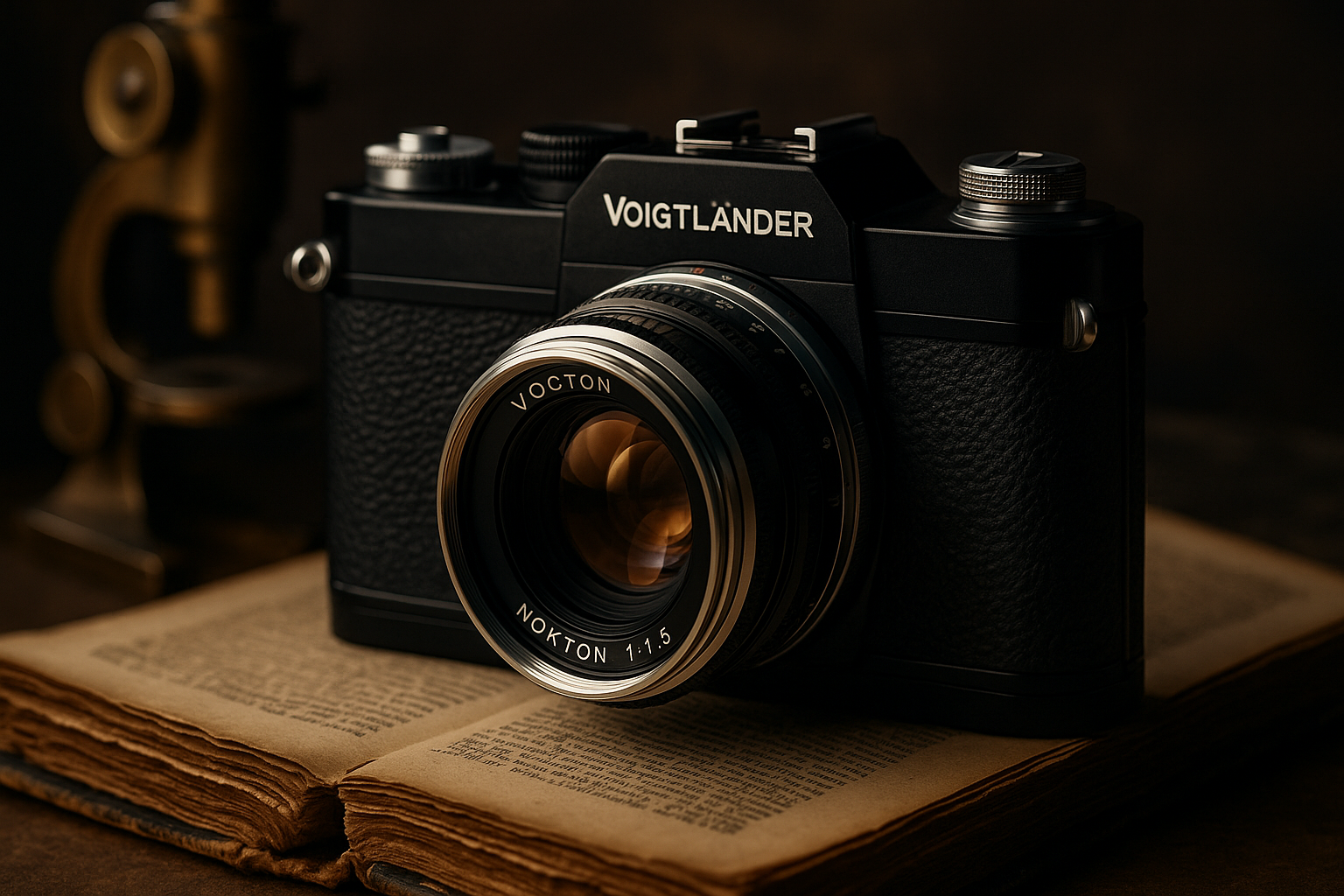
From an Austrian optical workshop to Japanese production: the history of Voigtländer tells of the rise and fall of one of the world's oldest photographic companies, which changed the history of photography.
Voigtländer: A Photography Legend from 1756 to the Present Day
When we talk about the oldest names in the world of photography, Voigtländer holds a special place. Founded in 1756 in Vienna by Johann Christoph Voigtländer, this name has become synonymous with quality and innovation that has lasted for more than two centuries. But the history of this company is not just a success story. It is an epic saga of ups and downs, about how a German company changed the world of photography and then lost its place, only to be reborn in Japanese hands.
Beginnings: From Optics to a Photography Revolution
In 1756, Johann Christoph Voigtländer founded his workshop in Vienna as a manufacturer of mathematical instruments and optics. Initially, the company produced opera glasses, eyeglass lenses, and monocles—products that brought it recognition and success. But the real revolution began when the founder's son, Johann Friedrich, passed the business to his son, Peter Wilhelm Friedrich Ritter von Voigtländer.
Peter was a brilliant optician who understood the potential of the new technology—photography. From 1840, he began producing lenses and optics for cameras, and in 1840 Voigtländer introduced the first all-metal camera for daguerreotypes—Ganzmetallkamera, equipped with a high-quality Petzval lens. This was a breakthrough that positioned the company as a leader in the new field of photography.
Golden Age: Innovations and Global Recognition
At the beginning of the 20th century, Voigtländer became a technological leader. The company released the popular "Alpine" camera in 1905, and from 1910 began mass-producing film cameras "Berg Heil" and "Avus." At the start of the 20th century, the company created the legendary Heliar and Skopar lenses, which became the benchmark of quality in optics.
But Voigtländer's true greatness was manifested in its innovations. In 1930, production of the medium-format camera "Bessa" began—a name that would become iconic for the company. In 1931, the "Brilliant" camera appeared. However, the company did not release small-format cameras for a long time, starting with the Vito camera only in 1939.
After World War II, Voigtländer continued to innovate. In 1952, the company began producing the world's first apochromatically corrected lens for medium-format cameras—the 4.5/105 mm Apo-Lanthar. In 1959, production of the world's first interchangeable zoom lens—36-82/2.8 Zoomar—began. In 1965, Voigtländer introduced the world's first 35mm compact camera with a built-in electronic flash—Vitrona. These achievements show that the company was not just a manufacturer but a pioneer that defined the future of photography.
Relocation and Expansion: From Vienna to Braunschweig
In 1849, Voigtländer opened a branch in the German city of Braunschweig, which was one of Europe's leading technological centers. This was a strategic move—the city was closer to German ports, facilitating product export. In 1862, the company fully relocated from Vienna to Braunschweig, where it remained for the next two centuries.
Decline: Competition and Loss of Leadership
Despite its innovations, by the mid-1960s, Voigtländer began to lose its position. Japanese manufacturers, especially Pentax and Nikon, started offering competitive products at lower prices. This was a problem that many European companies could not cope with. In 1898, Voigtländer became a joint-stock company, and in 1925, Schering AG acquired a controlling stake. In 1956, the company was sold to Carl-Zeiss-Stiftung.
The biggest blow came in 1971. The Voigtländer factory, employing 2,037 people, was closed. In 1973, the factory was divided equally between Carl Zeiss, Rollei, and the Lower Saxony government. Eventually, Rollei became the sole owner, and the company began producing cameras under the Voigtländer brand at its factory in Singapore.
Rebirth in Japanese Hands: Cosina and a New Era
The story of Voigtländer could have ended in 1982 when Rollei faced financial collapse. But in 1997, the Japanese company Cosina acquired the rights to the Voigtländer brand. From 1999, Cosina began developing and producing products under the Voigtländer brand, reviving the Bessa rangefinder camera series.
This was a turning point. Cosina, already a well-known photographic company, took on the mission of preserving Voigtländer's legacy. Bessa cameras, equipped with various mounts—from Leica L39 to M-mount—remained in production until 2015. From 2009, Cosina and Fujifilm jointly developed the medium-format Voigtländer Bessa III camera.
What Did Voigtländer Lose?
The company lost its place as a European leader in photography. It lost its independence when it came under the control of other companies. It lost its factory in Braunschweig, where thousands of people worked. It lost the ability to compete with Japanese giants on equal terms. But most of all, it lost its autonomy in development and production.
What Did Voigtländer Gain?
Paradoxically, the loss of independence gave Voigtländer a second chance. Under Cosina's leadership, the company preserved its legacy and continued to produce quality optics and cameras. Today, Voigtländer produces lenses for modern systems—MFT cameras from Olympus and Panasonic, Z-Mount lenses, and other modern products. The company gained the opportunity to remain relevant in the digital age when many of its competitors disappeared.
Conclusion: A Legend That Lives On
Voigtländer is not just a success story but a story of adaptation and survival. From an Austrian optical workshop to Japanese production—this journey shows how the company changed to stay relevant. Today, in 2026, Voigtländer still exists, still produces quality optics, and still bears the name founded in 1756. This proves that a true legend does not die—it simply transforms.








Comments (0)
No comments yet. Be the first to comment!
Leave a Comment