

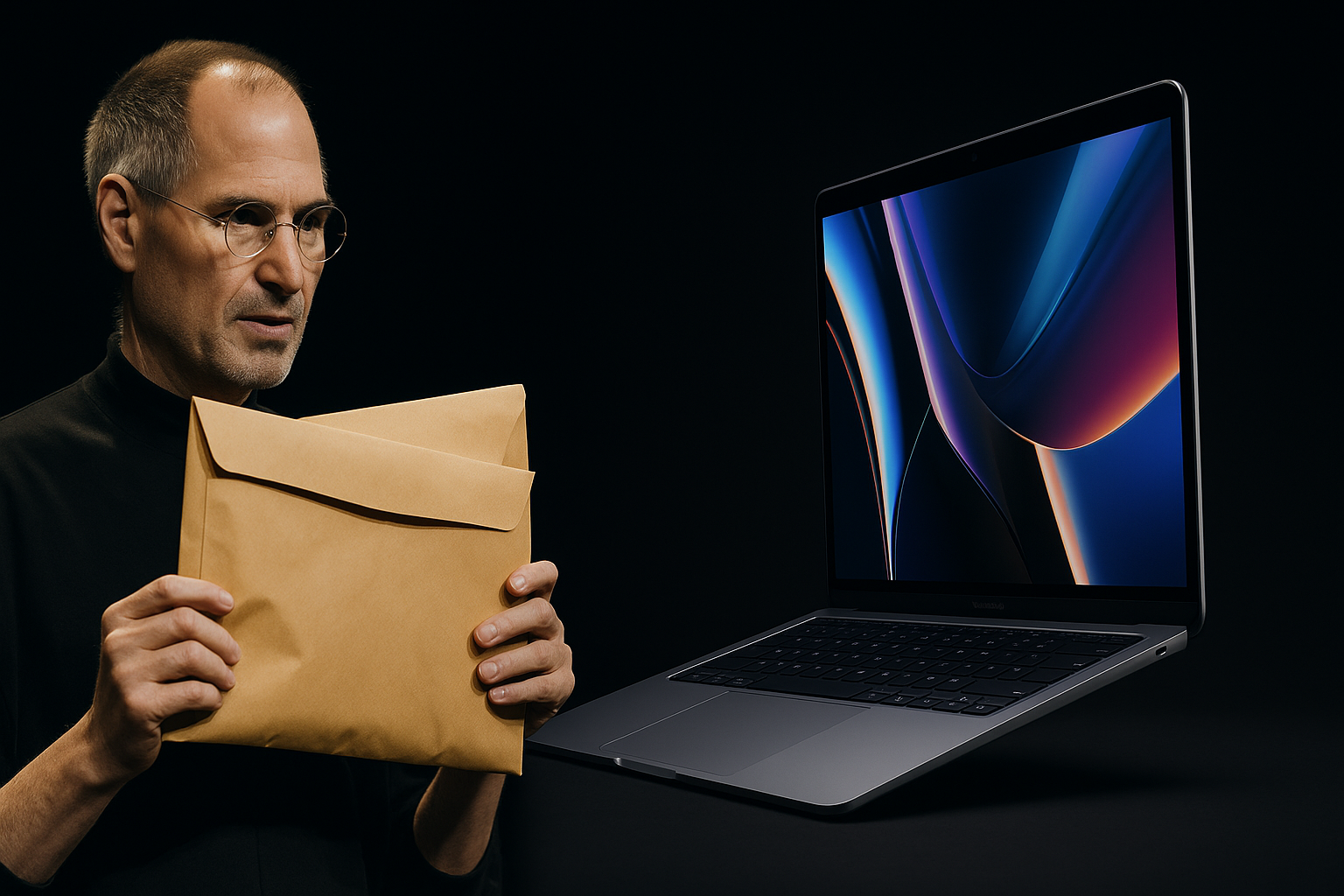
From Steve Jobs pulling it from an envelope in 2008 to the M4-powered beasts of 2025, explore the MacBook Air's history, innovations, and why it's the ultimate laptop for most users. Discover key milestones and stats.
The MacBook Air has redefined what a laptop can be since its dramatic debut in 2008. Born from Steve Jobs' vision of ultimate portability, it evolved from a niche ultraportable to the go-to choice for millions, blending sleek design, long battery life, and powerhouse performance.Today, with the M4 chip, it offers up to 20 hours of battery life, making it more relevant than ever.
The Iconic Launch: 2008 Unibody MacBook Air
In January 2008, at Macworld Expo, Steve Jobs stunned the audience by sliding the world's thinnest laptop—a 13-inch MacBook Air—from a manila envelope. Measuring just 0.16 inches at its thinnest and 0.76 inches at its thickest, it was a game-changer. Powered by a 1.6GHz Intel Core 2 Duo, it featured a solid-state drive (SSD) instead of a traditional hard drive, prioritizing speed and silence over capacity.
Interesting fact: The keyboard was backlit, and it lacked an optical drive—Apple included a Mail external DVD drive as an optional accessory. Priced at $1,799, it quickly captured over 50% of the thin-and-light market by 2013, attracting both loyal Apple fans and newcomers with its portability.
Expansion and Refinement: 2010–2017 Tapered Era
By October 2010, Apple introduced a tapered unibody design and an 11-inch model alongside the refreshed 13-inch. The smaller sibling was nearly iPad-sized, offering affordability (starting at $999) and appeal to students and travelers. Its battery lasted up to 5 hours, impressive for the time.
- 2011: 11-inch became the entry-level MacBook, replacing the white plastic MacBook.
- 2012–2014: Incremental updates with Ivy Bridge and Haswell processors improved efficiency.
- 2015: Force Touch trackpad and better SSDs; 11-inch phased out by 2016 to focus on 13-inch.
These years solidified the Air's reputation. Business execs and students loved its 'cuteness' and suitability for everyday tasks like browsing, email, and light productivity.
Why It Resonated: Portability Meets Practicality
Analytics show the Air's dominance: From 2008–2017, it was the bestseller in ultrabooks, with models like the 2015 Early refresh (A1466) supported until 2017. Its aluminum unibody was durable yet weighed under 3 pounds, perfect for on-the-go use.
The Retina Renaissance: 2018 Update
After years without major changes, the 2018 MacBook Air got a Retina display, slimmer bezels, Touch ID, and USB-C ports. At 0.61 inches thick and 2.75 pounds, it was lighter and more modern. The 13.3-inch True Tone display and butterfly keyboard aimed for premium feel, though the keyboard later faced criticism.
Milestone: This refresh bridged Intel era to Apple Silicon, maintaining affordability at $1,099. Minor updates followed in 2019–2020 (Intel 10th-gen), but performance lagged behind competitors.
Apple Silicon Revolution: 2020–Present
The game-changer arrived November 2020: the M1 MacBook Air. Apple's first custom ARM-based chip integrated CPU, GPU, and Neural Engine on one die, delivering desktop-class performance in a fanless design. Battery life jumped to 18 hours, and it started at $999.
It crushed benchmarks—up to 3.5x faster than Intel predecessors—while sipping power. No more butterfly keyboard; the reliable Magic Keyboard returned.
M2 Era (2022–2023): Design Overhaul and Variety
July 2022 brought the M2 Air with a flat-edge design inspired by iPad Pro, in colors like Midnight and Starlight. A 15-inch model debuted in 2023 ($1,299), offering larger screens without bulk (3.3 pounds). Battery hit 18 hours; prices adjusted to $1,099 for 13-inch.
- Touchstrip replaced function keys.
- Up to 24GB unified memory for pros.
- 15-inch filled the gap between 13-inch Air and 14-inch Pro.
M3 and M4: Peak Performance (2024–2025)
March 2024: M3 Airs (13/15-inch) with hardware-accelerated ray tracing. Then, March 2025's M4 update retained the design but added:
- Two external displays (lid open).
- Sky Blue color, 12MP Center Stage camera.
- 20-hour battery—the longest yet.
- Lower starting price.
November 2024 saw M4 Pro/Max in Pros, but Air stayed fanless and affordable.
Why MacBook Air Remains the Most Valuable Laptop
For most people—students, professionals, creators—the Air excels in balance: 80% of users don't need Pro-level power, but crave portability, battery, and ecosystem integration.
EraKey StrengthBatteryPrice2008–2017 (Intel)Portability Pioneer5–12 hrs$999+2018–2020Retina Refresh12 hrs$1,0992020–2025 (Silicon)Performance Leap18–20 hrs$999–$1,299Analytics: M1 was among the first Apple Silicon Macs, shifting from Intel entirely by 2020. Refurb stats show high demand for M1/M2 models even years later. It's captured student markets (lightweight for campuses) and execs (silent, secure with Touch ID).
Interesting facts:
- 11-inch Air was iPad-sized but outpowered netbooks.
- M-series enables fanless design—zero noise for calls or focus work.
- 2025 M4 supports two 6K displays, rivaling Pros for hybrid workers.
The Air's evolution proves Apple's genius: innovate quietly, prioritize user needs. It's not just a laptop; it's freedom—work anywhere, charge rarely. As of 2025, with M4, it's thinner, faster, and greener than ever, cementing its throne as the most valuable laptop for most people.







Comments (0)
No comments yet. Be the first to comment!
Leave a Comment