

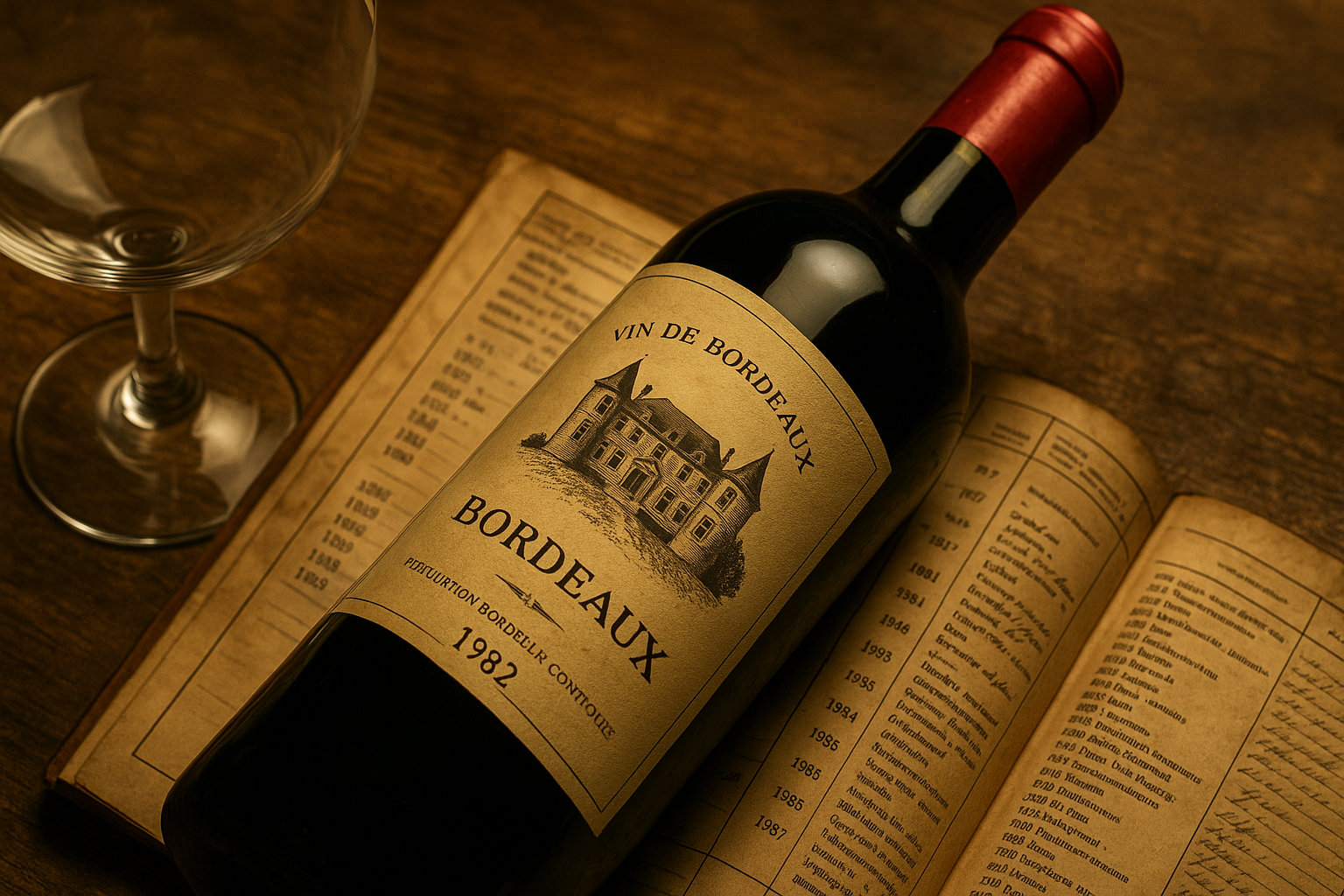
Bordeaux is a region where the vintage year matters as much as the name of the château. We analyze the vintage calendar from the 1980s to 2024: from the uneven 80s to the golden era of the 2010s and the new climate reality. Why does a 'great year' not guarantee success?
Bordeaux is one of the few wine regions in the world where the concept of vintage holds almost sacred significance. Here, the harvest year often weighs as much as the château name. However, Bordeaux can be misleading: a "bad year" can produce excellent wine, while a "great vintage" can disappoint if the context is not understood.
Over the last half-century, Bordeaux has experienced everything: cold and rainy years, extreme heat, climate shifts, changes in winemaking style, and technological leaps. Therefore, the harvest calendar is not a "good/bad" list but a tool for thinking. A region known since Ancient Rome produces over 700 million bottles of wine annually, mostly red, on 117,000 hectares of vineyards. Bordeaux's lands combine gravel, limestone, and sand, while the mild climate from the Garonne, Dordogne rivers, and the Atlantic creates ideal conditions for Cabernet Sauvignon on the left bank and Merlot on the right.
1980–1990s: Inequality and Character
The vintages of the 1980s and early 1990s clearly show how dependent Bordeaux was on the weather. Strong years like 1982, 1985, 1989, or 1990 are now considered classics: 1982 is legendary for its concentration and longevity, 1990 for its elegance and balance. But alongside these were frankly weak or challenging seasons — for example, 1984 with excessive rains or 1992 with a cold summer leading to unripe grapes.
In these decades, the difference between a good and a weak producer was colossal. In difficult years, those with old vines, better soils, and discipline in the vineyard survived. That's why today, wines from those years should be bought not "by year" but by specific château. For example, in 1984, top châteaux like Château Margaux or Château Latour produced decent wines thanks to strict selection, while average producers failed. The 1855 classification, created for the Paris Exhibition, still defines the elite: Premier Grand Cru Classé like Mouton Rothschild or Margaux.
2000–2009: Stabilization and the First "Golden Period"
The early 2000s marked a turning point. The year 2000 immediately set a high standard: perfect summer, full ripeness, wines with powerful tannins and a potential for aging 20–30 years. 2003, despite extreme heat (temperatures up to 40°C), showed that Bordeaux can adapt — the wines came out concentrated, with jammy notes, especially Merlot on the right bank.
The culmination of the decade was 2005, 2007, and 2009 — years still considered benchmarks. 2005 had the perfect balance of acidity and fruit, 2009 had monstrous concentration. It's important to understand that from this point, even "average" vintages stopped being failures. Technologies — fermentation control, clone selection, sustainable winemaking — did their job. There were fewer outright bad years, and hand harvesting, traditional for premium châteaux, ensured quality.
2010–2019: The Era of Great and Very Great Years
The 2010s are, without revision, one of the strongest periods in Bordeaux's history. 2010, 2012, 2015, 2016, 2018 — each of these years is rated excellent or outstanding. 2010 is structured, with velvet-like tannins; 2016 is elegant, with freshness; 2018 is powerful, sunny.
Interestingly, climatic challenges (heat, drought, spring frosts) no longer destroy quality but only change the style. Wines become more concentrated, ripe, with softer tannins, yet they maintain balance — especially in strong estates. Even challenging years like 2013 (rainy summer) or 2017 (frosts) don't seem catastrophic if chosen wisely: left-bank Cabernet fared better. The region is divided into 57 appellations, from Médoc to Saint-Émilion, where the terroir dictates the style.
2020–2024: A New Reality
Recent years clearly show that Bordeaux is entering a new climatic phase. 2020 and 2022 are very strong, structured, serious years: 2020 with cool ripening gave freshness, 2022 with record heat but high acidity. 2021 and 2023 are cooler, classic in style, with less uniformity: right-bank Merlot shone in 2021.
2024 is currently rated very high — dry summer, full ripeness, but final conclusions will be made in a few years in the bottle. Climate is changing Bordeaux: more warmth, less rain, which benefits Cabernet Sauvignon but requires new practices.
Why the "Calendar" is Only Half the Truth
The most common mistake is buying Bordeaux wine solely by year. In reality, more important questions are:
- Left or Right Bank? Left (Médoc, Graves) — Cabernet dominates, structured, long-lasting wines. Right (Saint-Émilion, Pomerol) — Merlot, softer, fruity.
- Cabernet or Merlot Dominant? Cabernet — tannic, aromatic; Merlot — velvety, high alcohol.
- Big Château or Small Producer? Classified châteaux are stable, but garagistes like Château Pontet-Canet or angelic wines from the Right Bank surprise in weak years.
- For Aging or Drinking Now? Great vintages (2009, 2016) for cellaring, average ones — drink young.
In a weak year, a major producer can make a very decent wine. In a great year, a mediocre winemaker can easily "get lost" amid expectations. Bordeaux is 9,000 châteaux, from industrial to boutique.
Conclusion
The Bordeaux harvest calendar over the last 50 years shows the main thing: the region has become more stable, stronger, and technically mature. But it hasn't become simpler. Reading vintages requires critical thinking, understanding context and style. Bordeaux rewards those who ask the right questions, not those who seek the "best year."







Comments (0)
No comments yet. Be the first to comment!
Leave a Comment