

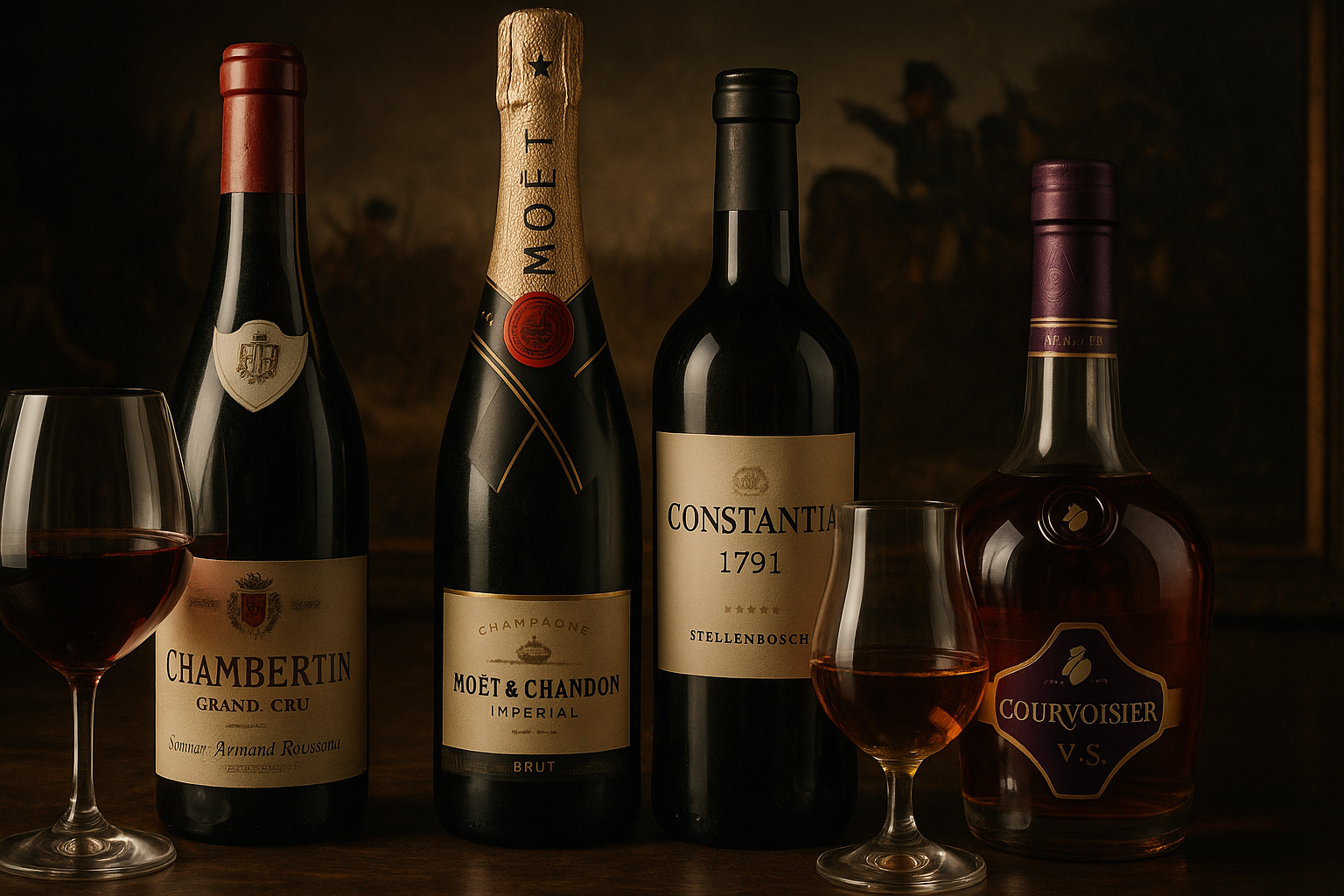
Chambertin, Moët & Chandon champagne, South African Constance, and Courvoisier cognac: how wines accompanied Napoleon in his campaigns and on the island of Saint Helena.
Napoleon Bonaparte entered history as a brilliant military leader and reformer, but his role as a passionate wine connoisseur remains less known. For the emperor, drinks were not only a pleasure but also a part of his image, politics, and even military luck. On the battlefield, at court, and in exile, Napoleon was accompanied by several favorite wines that later became legends.
Chambertin: the red Burgundy without which the day did not begin
Historians and wine authors agree that one of Napoleon's main favorite wines was the red Burgundy from the commune of Gevrey-Chambertin, especially the wine from the Chambertin vineyard – a powerful, concentrated Pinot Noir with great aging potential.
Chambertin is grown on the vineyard of the same name, whose name comes from "Bertin's field" – a plot that once belonged to a local winemaker Bertin and was later purchased by the monks of the Abbey of Bèze. The wine from this vineyard quickly gained a reputation as one of the best in Burgundy – it was regularly served at the imperial table, according to testimonies.
One of Napoleon's companions in exile on the island of Saint Helena, Count de Las Cases, recalled that the emperor highly valued this Burgundy wine. It was often paired with Époisses cheese – a soft cow's milk cheese with a strikingly sharp aroma that pairs well with the rich Chambertin.
Chambertin as the emperor's "wine ritual"
For Napoleon, Chambertin was more than just red wine:
- Daily companion in campaigns – Napoleon, according to testimonies, always had a supply of Burgundy with him when going on campaigns.
- A drink for concentration – he believed that a moderate amount of good wine helps to gather thoughts and maintain strength.
- Part of personal style – the preference for a specific Burgundy terroir fit well with the image of the emperor, who emphasized the greatness of French taste.
Symbolically, Chambertin is often mentioned when talking about "Napoleon's favorite wine."
Champagne: Moët & Chandon as a talisman of success
The emperor was a sincere patriot of French winemaking and was particularly proud of the wine from Champagne. He actively supported the development of the region and sought for Champagne winemakers to achieve international recognition.
Among the numerous producers, the house of Moët & Chandon held a special place in his life, then known primarily for the activities of Rémy Moët. It was this house's champagne that Napoleon chose as his "battle drink."
The friendship of Napoleon and Rémy Moët
The stories about the emperor's relationship with champagne are almost a ready-made script:
- Before each campaign Napoleon would stop by Épernay – the city where the headquarters of Moët & Chandon are still located today – to replenish his supply of favorite champagne.
- Rémy Moët valued his friendship with the emperor so much that he built a replica of the Grand Trianon from Versailles in Épernay to properly host Napoleon and Josephine.
- A few weeks before his downfall, Napoleon awarded Rémy Moët the Legion of Honor – a gesture that immortalized the alliance between the empire and the champagne house.
In memory of this historical friendship, Moët & Chandon later created the champagne Impérial, the first release of which was timed to the centenary of Napoleon.
Champagne on the battlefield and in politics
For Napoleon, champagne served several functions:
- The drink of triumphs – it was used to celebrate victories and important events, including the wedding with Marie-Louise, for which Napoleon ordered champagne from another house, but Moët remained a faithful partner.
- A political symbol – the popularity of French champagne at European courts was an indirect demonstration of France's influence.
An interesting detail: during the 1812 campaign against Napoleon, Russian Emperor Alexander I banned the import of French bottled wines, especially champagne, which could not be transported in barrels. This was not only an economic but also a symbolic blow to the emperor and the champagne houses.
Constance: "sweet solace" in exile
During his exile on the island of Saint Helena, Napoleon discovered another wine world – South African wines from the Constantia region near Cape Town. He particularly loved the sweet wine Vin de Constance (or Grand Constance), which was considered an elite dessert drink of its time.
Sources note that Napoleon allowed himself to indulge in Grand Constance on the island of Saint Helena until his last days. One of the bottles from the 1821 vintage – the year of the emperor's death – was sold at auction many years later for a significant sum, highlighting the historical value of this wine.
Why Vin de Constance?
The reasons for Napoleon's affection for South African wine can be summarized in several points:
- Unique taste – the concentrated sweetness, bright fruitiness, and complex bouquet made Vin de Constance one of the most prestigious dessert wines of the 19th century.
- Availability in exile – due to British control of sea routes, South African wines could be more regularly delivered to Saint Helena than European ones.
- Psychological aspect – in solitude and political isolation, sweet wine became a small luxury and a reminder of former greatness for the emperor.
Cognac Courvoisier: from imperial favorite to marketing legend
Although the question concerns wines, another key drink in Napoleon's life cannot be overlooked – Cognac Courvoisier. This house positions itself as "Napoleon's favorite cognac."
In 1811, Napoleon visited the Courvoisier production, where he first tasted cognac and was so pleased that he made the house the official supplier of alcohol for his court. Subsequently, Courvoisier became an integral part of the imperial image as a noble French digestif.
Courvoisier on the way to Saint Helena
There is a popular legend: when setting off for his final exile on the island of Saint Helena, Napoleon did not forget to take several barrels of his favorite Courvoisier cognac with him. Whether the number of barrels was as significant as marketers sometimes claim is hard to say, but the story has become so entrenched that it became part of the brand.
Later, the Courvoisier house actively used this association, launching a series of cognacs "Courvoisier Napoleon", which emphasized the historical connection of the brand with the emperor. Thanks to this, Courvoisier is still associated with the imperial era and refined taste.
What unites Napoleon's favorite drinks
Looking at all the drinks Napoleon loved, one can see a certain logic in his choice.
Common features of "imperial" wines
- High quality and status – Chambertin, Moët & Chandon champagne, Vin de Constance, and Courvoisier cognac were elite products of their time, associated with prestige.
- Strong character – powerful Burgundy, expressive champagne, dense dessert wine, and noble cognac had a bright, "imperial" style.
- International resonance – each of these drinks, in one way or another, went beyond France, shaping the country's image in Europe and the world.
Wine as part of the strategy
For Napoleon, alcohol was never an end in itself. He was relatively moderate in consumption but attentive in choice. Wine, champagne, and cognac worked on several levels:
- Personal enjoyment – the emperor openly loved quality drinks.
- Diplomacy – the etiquette of receptions and banquets demanded the best, and Napoleon gladly demonstrated the superiority of French winemaking.
- Myth-making – stories about champagne before battles, Chambertin in campaigns, and Constance in exile became part of Napoleon's figure in cultural memory.
How to "drink like Napoleon" today
For the modern wine connoisseur, Napoleon's story is not a call to excess but rather an inspiration to be more attentive to the choice of drink, understand its origin and character.
- Try classic Burgundy from Gevrey-Chambertin – it's a direct bridge to the emperor's taste.
- Discover Brut Impérial style champagne from historic Champagne houses – a symbol of drinks for great events.
- Find Vin de Constance from South Africa – a modern revival of Napoleon's legendary dessert wine.
- Conclude the tasting with a glass of Courvoisier cognac or another quality cognac, paying tribute to imperial traditions.
Napoleon's favorite wines are not only a historical fact but also a kind of taste map of the era. They allow us to glimpse into the private world of a man who changed the course of European history and feel how power, ambition, and enjoyment of life are combined in a glass.








Comments (0)
No comments yet. Be the first to comment!
Leave a Comment