

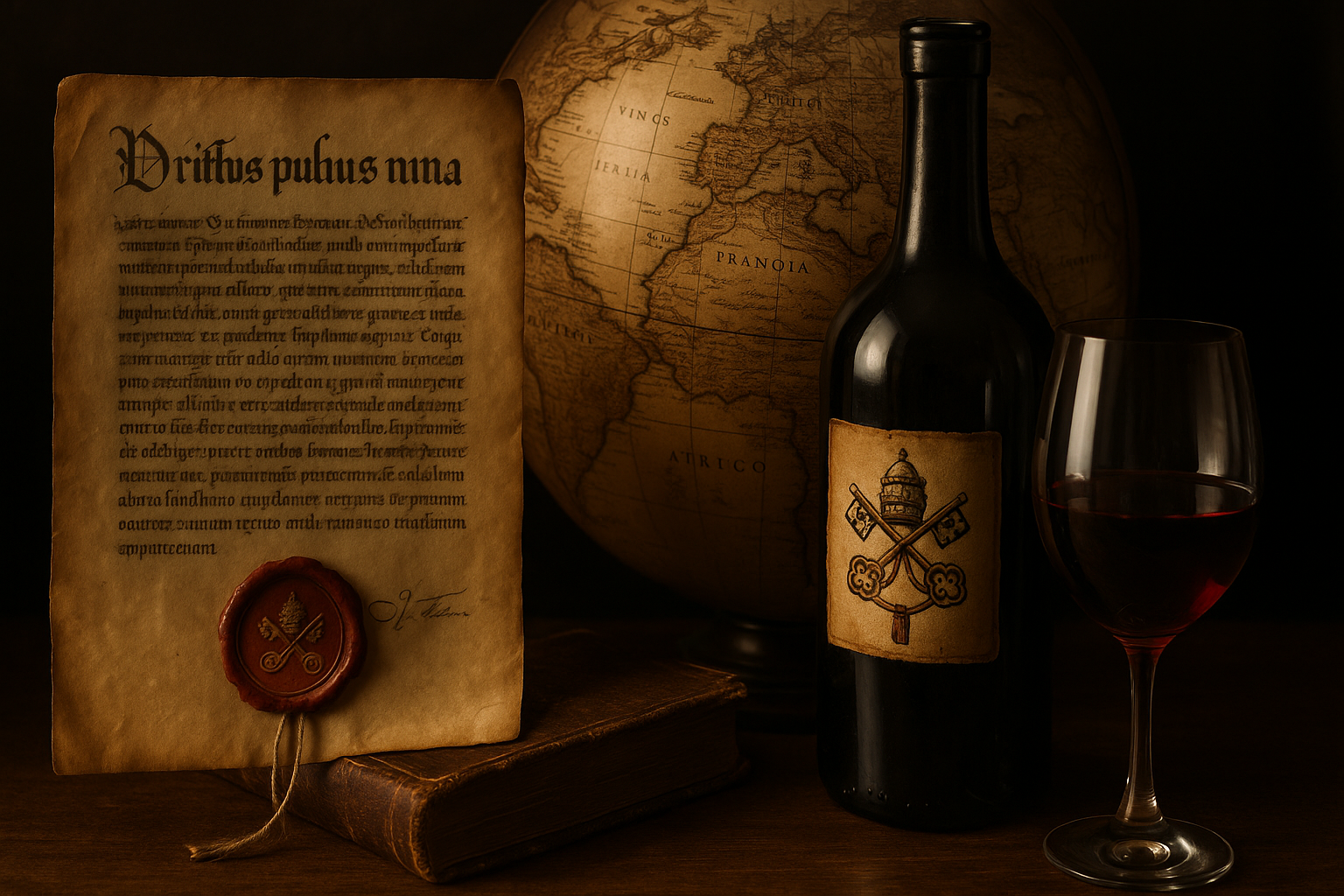
How papal bulls, tithes, and monastic orders turned Europe into a map of wine regions – from worship to terroir branding.
The history of European winemaking is impossible without the church. For hundreds of years, it was the popes, bishops, and monastic orders that determined where the grapevine would be planted, which lands would receive tax benefits, and which wines would become the standard for the entire continent. Papal privileges and church laws shaped not only the spiritual but also the economic landscape of Europe, turning certain areas into recognizable wine regions.
Why the church cared so much about wine
For the Catholic Church, wine was not just a product – it had a sacred status. In the Eucharist, wine symbolizes the Blood of Christ, and thus, without stable supplies of quality wine, it was impossible to conduct services. This created a constant demand and encouraged the church to directly influence winemaking.
Monasteries and episcopal estates became centers of agricultural innovation. It was there that soils, altitude, microclimate were systematically studied, and the best grape varieties were selected. In practice, this meant: where the church had strong positions, there was a higher chance of developing winemaking protected by privileges.
Papal privileges: what they really were
Under papal privileges regarding winemakers, one can understand a whole set of church authority tools that influenced wine and vineyards.
1. Papal bulls and charters
The popes issued special bulls (solemn charters) that could:
- exempt specific monastic or episcopal vineyards from part of secular taxes;
- guarantee monks and clergy the right to freely trade wine in certain cities and ports;
- confirm or expand the land holdings of church institutions where the grapevine already grew.
Such documents often became the legal basis for future wine regions: the right to plant grapes, collect taxes from winemakers, or trade wine in certain zones was secured by the papal seal.
2. Tithe on grapes and wine
A classic mechanism of influence – the church tithe. Part of the grape and wine harvest, peasants and townspeople were obliged to give for the benefit of the parish or bishop. In a number of Eastern European cities, it was directly recorded that the priest received a tithe not only from grain but also from grapes, and during the harvest, he was to be fed and maintained at the community's expense.*
This created a dual effect:
- the church was financially interested in the development of vineyards – the more the harvest, the larger the tithe;
- winemakers received some protection – because their work directly provided for church needs and services.
*Medieval sources regarding Central-Eastern European cities repeatedly mention the obligation to pay a tithe specifically from grapes and wine.
3. Prohibitions and monopolies
Church and related secular owners often imposed restrictions on other alcoholic beverages to support winemaking. In a number of Central European cities, brewing beer or strong drinks was prohibited, and residents were obliged to buy wine from manorial or church vineyards. This effectively created local monopolies on wine and stimulated the development of the wine industry.
Monasteries as laboratories of terroir
It was the monastic orders – Benedictines, Cistercians, Augustinians, and later others – that became the main "engineers" of European wine landscapes.
Systematic approach to vineyards
Monasteries owned significant lands and human resources, allowing for long-term agricultural experiments. Monks:
- divided vineyards into plots, observing the difference in wine quality depending on the soil and slope exposure;
- recorded yields, taste changes, weather impact; in a sense, they kept the first "winemaker's journals";
- formed ideas about "better" and "worse" plots, from which the concept of terroir later emerged.
This experience was passed on to other regions of Europe along with the spread of the orders, and papal privileges guaranteed monasteries stability and the inviolability of their holdings.
Network of church estates as a prototype of wine regions
When several monasteries of one order in different parts of Europe received papal confirmations of their lands and rights to winemaking, a "network of quality" gradually formed. Professional winemaking practices, supported by church law, created the reputation of entire zones, which we today call wine regions.
How papal decisions changed the geography of wine
Shifting centers of influence: Avignon and wine valleys
The period when the papal court was in Avignon contributed to the rise of the surrounding vineyard zones. The needs of the curia, the diplomatic court, and pilgrims created a huge demand for wine. In response, there was an increase in:
- investments in vineyards around the papal residence;
- legal protection of products and lands, secured by bulls and privileges;
- the formation of the reputation of local wines as "papal."
Similar processes occurred wherever the center of church power shifted: with the appearance of episcopal cathedrals, large monastic complexes, or important pilgrimage routes.
Church documents as a source on winemaking
Papal registers and tithe records have become one of the main sources of data for historians on medieval wine zones. For example, in the papal tithe lists of the 14th century, settlements and parishes that paid contributions, including from winemaking activities, are recorded. This allows for the reconstruction of where vineyards already existed and how they were integrated into the church economy.*
*Records of papal tithes from the 1330s mention a number of Central-Eastern European settlements, demonstrating the deep integration of local communities into church financial networks.
Privileges, taxes, and conflicts
Despite the privileges, the system was not perfect. Where the church and related landowners excessively raised taxes on wine or changed trade rules, conflicts arose.
When privileges turned into a burden
In urban communities of Eastern and Central Europe, there are recorded cases where new estate owners – including bishops or their appointees – increased taxes on vineyards, introduced additional levies, and prohibited the free sale of wine. For cities whose economy depended on wine, this was a disaster: half of the income was lost, uprisings occurred, and there was a struggle to restore old rights.
Such conflicts demonstrate that church law could both support and restrain the development of wine regions – depending on the policies of specific rulers.
Balance between sacred and commercial
For the church, it was important to maintain a balance: on one hand, to ensure services and monastic economy, on the other, not to allow the decline of local communities. Successful wine regions grew where this balance was found: the tithe was set so that winemakers remained interested in expanding vineyards, and church courts protected them from excessive claims by secular feudal lords.
The legacy of papal privileges in the modern wine world
Today, on the labels of many European wines, we see the names of regions that were formed back when the church was the main player in winemaking. The structure of land holdings, the configuration of vineyards, even traditional wine styles often have roots in medieval monastic practices.
What has been preserved to this day
- Clear zoning – the division into better and worse plots, initiated by monasteries, is now enshrined in systems of origin control.
- Cult of terroir – the idea that a specific place, soil, and microclimate give unique wine, first systematically comprehended in church estates.
- Combination of spiritual and gastronomic – the tradition of perceiving wine not only as a commodity but as part of culture, ritual, and hospitality.
Conclusion for the modern winemaker and reader
Papal privileges for winemakers are not just a page of church history. They are the key to understanding why the wine maps of Europe look the way they do. Monasteries and episcopal estates acted as the first investors, scientists, and regulators of the wine market. They set quality standards, formed terroirs, and secured them in legal documents.
When we taste wine from a historical region today, we often do not realize that its reputation is backed by centuries of church policy: papal bulls, tithes, monastic statutes, and conflicts between winemakers and authorities. Understanding this heritage makes a glass of wine not only more aromatic but also deeper in meaning.








Comments (0)
No comments yet. Be the first to comment!
Leave a Comment