

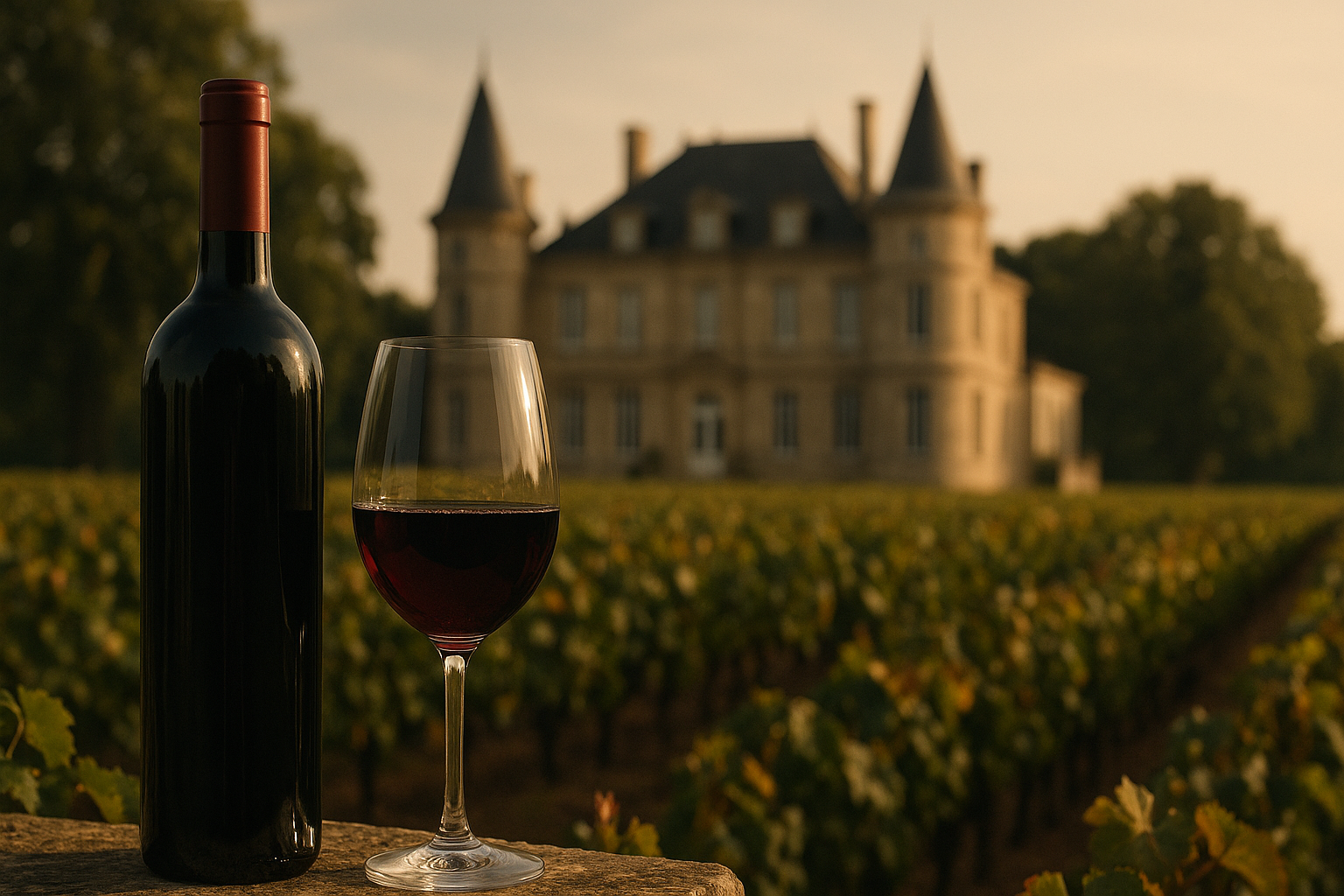
Discover the elegant wine world of Margaux — from Berlon's revolutionary methods to modern innovations. The history of the terroir that has shaped French wine for five centuries.
Margaux: Legend of Bordeaux from the 16th Century to Today
When you hear the word "Bordeaux," an image of refined wine with soft tannins and floral notes appears before your eyes. But behind this simplicity lies five centuries of hard work, revolutionary ideas, and family traditions. Margaux is not just a wine; it's a story of European culture written in barrels.
Where It All Began: From "Mont Margaux" to the Cellar
The place we know today as Château Margaux was known as early as the 12th century as "La Mothe de Margaux" — "Mont Margaux." But at the time, there was no vineyard. Everything changed when the English conquered Aquitaine (1152–1453) and discovered Bordeaux wines. Suddenly, there was a huge demand for "claret" — a clear, easy-to-drink wine — in misty Albion.
The Lestonnac family played a decisive role in the creation of the estate. Pierre de Lestonnac acquired the estate from his cousin and, from 1572 to 1582, expanded it, built a new château, and increased the vineyard area. By the end of the 17th century, Château Margaux occupied 265 hectares — a size that has remained unchanged to this day. Since then, one-third of the estate is dedicated to vineyards, one-third to the forest planted in the 19th century, and one-third to pastures.
Revolution in the Vats: How Berlon Changed the Art of Winemaking
At the beginning of the 18th century, the quality of Médoc wines began to improve significantly. This happened thanks to one man — the steward of Château Margaux named Berlon. His ideas were so revolutionary that they changed the entire approach to winemaking.
Previously, red and white grapes were mixed directly in the vineyard and processed together. Berlon was the first to treat different grape varieties separately. He also prohibited harvesting grapes in the morning when they were covered with dew — as the moisture diluted the wine's color and made it pale. Berlon understood that the soil of the château's different plots was different, and therefore influenced the future wine. This was the beginning of modern oenology.
1855 Classification: When Margaux Received the Crown
The 18th century is called the golden age of Bordeaux — but then came the French Revolution. In 1793, Count Elie du Barry, then owner of Margaux, was guillotined, and his estate confiscated and sold at auction. The vineyards had to be replanted.
When the official classification of Bordeaux wines was carried out in 1855, Château Margaux received the highest status — Premier Cru. This title recognized not only the quality of the wine but also its exceptional character, history, and potential. For Margaux, it was the recognition of five centuries of work and innovations.
Margaux Appellation: Terroir That Shapes the Style
Margaux is not just the wine of a single cellar, but an entire appellation within the Médoc. It is a region with a particular microclimate and soils that shape the characteristic style of the wine.
Margaux wines are distinguished by their elegance, suppleness, and soft, generous tannins. Around the very village of Margaux, the "most beautiful" red Bordeaux wines with an unreal aroma are born. The main grape variety is Cabernet Sauvignon (about 75% of the vineyards), but Merlot (20%), Cabernet Franc, and Petit Verdot play an important role.
From Crisis to Renaissance: The Story of André Mentzelopoulos
The 1970s were catastrophic for Bordeaux. Three consecutive harvests unfit for sale (1972, 1973, 1974) put the owners in a deadlock. Even Château Margaux was on the brink of bankruptcy. It was about to be bought by the American corporation National Distillers & Chemical.
In 1977, the estate was acquired by the Greek billionaire André Mentzelopoulos. He invested in replacing old vines, installing drainage, and a strict declassification of wines not meeting standards. The first large underground cellar was built in the Médoc, and aging in new barrels was introduced.
In the 1990s, the estate was inherited by his daughter Corinne Mentzelopoulos. She revived the legendary estate and invited Émile Peynaud and Paul Pontallier, bringing Margaux back to the top of Bordeaux.
Modern Trends: From Organic to Climate Change
Château Margaux adheres to sustainability principles without official organic certification. The cows in the pastures provide natural soil fertilization.
Since 1986, the estate has practiced green thinning of clusters, increasing the concentration and quality of the wines. Climate changes require adapting harvest periods and agricultural techniques, but Margaux has the experience of surviving in difficult times.
8 Interesting Facts About Margaux
The neo-Greek style château was built in 1810.
Thomas Jefferson highly esteemed Château Margaux in 1787.
Pavillon Rouge became one of the first "second wines" of Bordeaux.
Pavillon Blanc has been produced since the 19th century.
In 1965, some wines were sold without a vintage.
The estate occupies 263 hectares.
Château Margaux has its own cooperage (1/3 of the château is occupied by the forest).
Corinne Mentzelopoulos is the first woman to have fully restored a Premier Cru Bordeaux.
Popular Myths About Margaux
Margaux is not always the most expensive, not always the best with aging, not only red, and not entirely organic. The appellation is diverse, and a beautiful label is not a guarantee of quality.
What to Taste and How to Choose
For beginners — younger vintages or wines from other producers in the appellation. For collectors — the legendary years: 1953, 1961, 1982, 1990, 2000, 2009, 2015. Pairs perfectly with beef, game, and aged cheeses.
Margaux is elegance in a glass and five centuries of culture in every sip. From Berlon to Mentzelopoulos — a constant evolution without betraying its roots.







Comments (0)
No comments yet. Be the first to comment!
Leave a Comment