

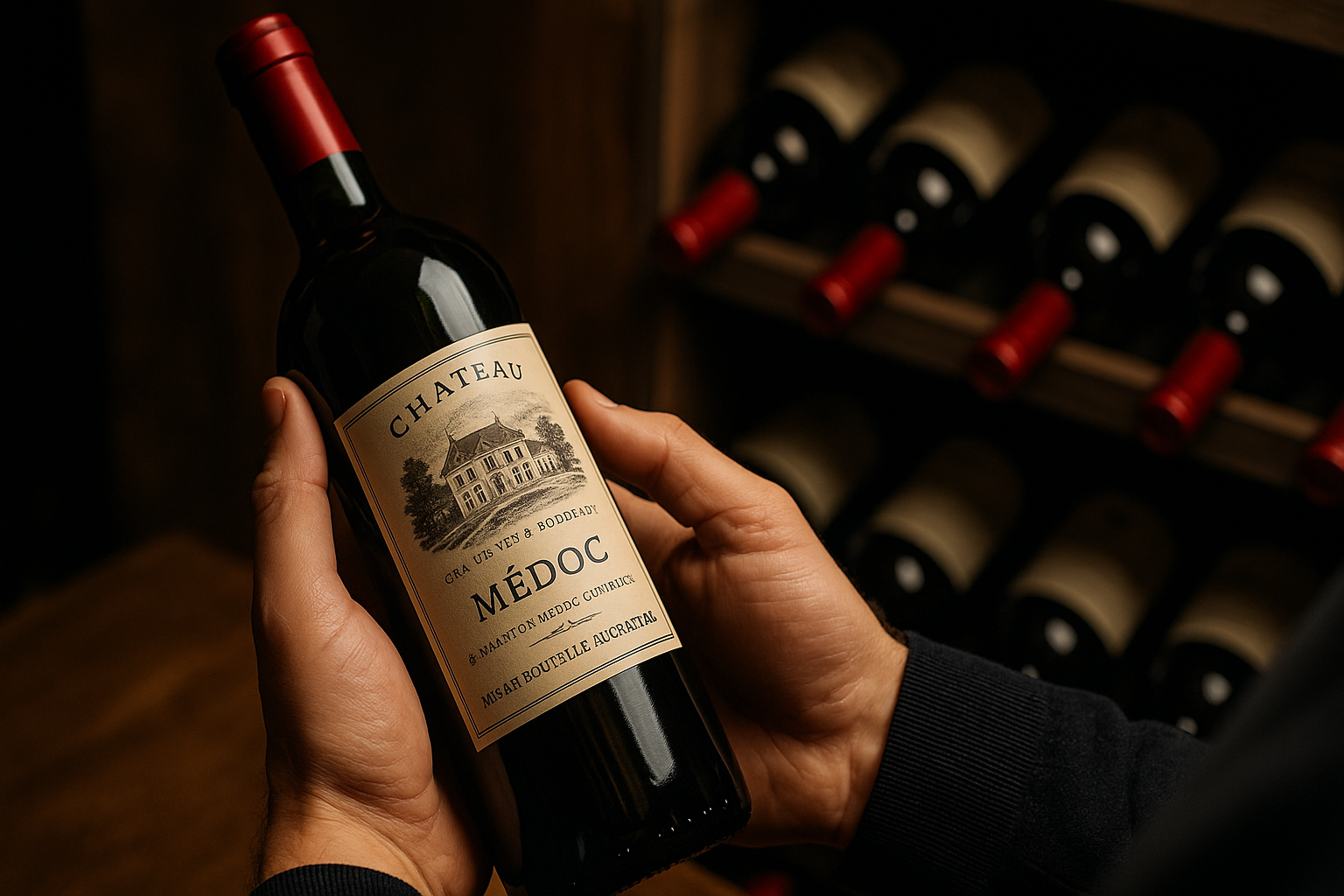
Learn how to understand the label of Bordeaux wine from Médoc: from the château name and appellation to classification and wine style.
Choosing a Bordeaux wine from Médoc on a store shelf often turns into a lottery: beautiful labels, loud inscriptions "Grand vin de Bordeaux," complex French names, and incomprehensible abbreviations. However, a Bordeaux wine label is a structured code that you can learn to read and always understand what exactly you are buying.
What is Médoc and why it is important on the label
Médoc is one of the key wine regions of Bordeaux, located on the left bank of the Gironde. The inscription "Médoc" on the label already hints at the wine style: predominantly red blends based on Cabernet Sauvignon, Merlot, and other Bordeaux varieties.
Within Médoc, there are smaller appellations (wine zones with controlled designation of origin) that you will also often see on the label:
- Haut-Médoc – "Upper Médoc," a zone with many famous châteaux;
- Pauillac, Margaux, Saint-Julien, Saint-Estèphe – prestigious communes with their own wine character;
- other smaller names that are less common for Ukrainian consumers.
The more precisely the place of origin is indicated (for example, Pauillac instead of just Médoc), the more clearly defined the style and the higher the demands on the producer.
Main elements of a Bordeaux wine label from Médoc
A Bordeaux wine label has a certain logic. If you understand what each line means, the choice becomes much simpler.
1. Name of the château (Château)
The largest inscription on the label is usually the name of the estate (château): for example, Château Lafite Rothschild, Château Margaux, etc. In Bordeaux, wines are traditionally named not by grape variety but by the estate that produces them.
What this information provides:
- the reputation of the château is often more important than individual technical details;
- if you liked the wine of a certain château in one vintage, it makes sense to look for it in other years;
- renowned châteaux almost always adhere to strict quality standards.
2. The inscription "Grand vin de Bordeaux" and similar formulas
On many bottles, you will see a phrase like "Grand vin de Bordeaux" – literally "great wine of Bordeaux." This is a marketing inscription that has no official legal meaning and does not guarantee classic classification or high château ratings.
Important: do not confuse such general formulas with specific appellation or classification designations – they are the key to understanding the wine level.
3. Appellation: AOC / AOP
French wines have an origin control system. On a Bordeaux wine label from Médoc, you will see an inscription like:
- Appellation Médoc Contrôlée or Appellation Médoc Protégée;
- Appellation Haut-Médoc Contrôlée;
- Appellation Pauillac Contrôlée – and so on.
This is the so-called AOC/AOP – controlled designation of origin, which means that the producer adhered to strict rules regarding grape varieties, yield, production method, and aging.
4. Vintage year (Millésime)
The year indicated on the label is not the year of bottling but the year of grape harvest (millésime). It is important because climatic conditions greatly affect the quality of Bordeaux wines.
Practical points:
- better Médoc vintages usually produce more structured and long-lasting wines;
- young Bordeaux wines can be more tannic and require decanting;
- older vintages are usually more expensive but may have softer tannins and a more complex bouquet.
5. Alcohol content and volume
The label must indicate:
- volume of the bottle (most often 750 ml);
- strength in percentage – for red Bordeaux wines from Médoc, this is usually 12.5–14% vol.
Strength indirectly indicates grape ripeness and wine style: a higher alcohol percentage often (but not always) means a riper, richer style.
6. Producer and importer
On the front or back label, you will find a mention like:
- Mis en bouteille au château – "bottled at the château," meaning the producer grows, produces, and bottles the wine themselves;
- Mis en bouteille par… – bottled by a certain company, which may be a négociant (intermediary).
For beginners, the "au château" mark is a simple guide to a more authentic product with full production control.
Classification of Médoc châteaux: what "cru" means
A separate layer of information on the label is the classification, which indicates the historically recognized level of the château.
1. Grand Cru Classé 1855
In 1855, for the World's Fair, an official classification of Médoc wines (and some sweet wines) was created. The wines of the left bank, including Médoc, were divided into five levels – from Premier Cru Classé (1st class) to Cinquième Cru Classé (5th class).
How to see this on the label:
- inscriptions like "Grand Cru Classé en 1855" or "Premier Grand Cru Classé";
- usually placed next to or below the château name.
The presence of such a mark indicates that the château is part of the historical list of the most prestigious estates in Médoc.
2. Cru Bourgeois and other categories
Besides "grand cru," there are other levels in Médoc that are sometimes indicated on the label:
- Cru Bourgeois – a category for quality châteaux not included in the 1855 classification but demonstrating a stable level;
- Cru Artisan – small independent producers with an emphasis on an artisanal approach;
- local classifications of individual communes or associations.
For beginners, the Cru Bourgeois mark is a good signal: it often offers a "price/quality" ratio above average.
Why the grape variety is not indicated?
Beginners are often surprised that classic Bordeaux labels, especially from Médoc, rarely mention grape varieties. Instead of "Cabernet Sauvignon" or "Merlot," you see only the château and appellation name.
Reasons:
- Bordeaux wines are blends of several varieties, not monovarietal wines;
- the focus is on the terroir (combination of soil, climate, traditions) and the reputation of the château;
- within one appellation, the ratio of varieties may change from year to year, maintaining the typical style.
If the variety is important to you, look for this information on the back label – many producers add an approximate blend composition for export.
How to "read" the wine style by the Médoc label: a step-by-step approach
To understand from the label approximately what wine is inside, use a simple algorithm.
Step 1. Look at the appellation
- If it says just Médoc or Haut-Médoc – expect a classic left bank style, with noticeable tannins and aging potential.
- If it specifies Pauillac, Saint-Estèphe, Saint-Julien, or Margaux – this is already a more specific style: from powerful and structured to elegant and aromatic, depending on the commune.
Step 2. Evaluate the vintage year
- A young year (conditionally, up to 5–6 years) – the wine is likely to be more fruity, with expressive tannins.
- An older year – tannins soften, notes of leather, tobacco, earth, and dried fruits come to the fore.
Step 3. Pay attention to the classification
- Grand Cru Classé – the highest level, often complex, structured wines with good aging potential.
- Cru Bourgeois – a good balance of quality and price, especially in simpler years.
- Without additional "cru" – does not mean bad, but it is worth looking more closely at the producer and price.
Step 4. Read the back label
On the back label, the producer often gives hints:
- a brief taste description (fruits, spices, oak, tannins);
- recommendations for gastronomic pairings (red meat, game, aged cheeses);
- serving temperature and aging potential.
Marketing traps and how to avoid them
Some inscriptions on the label sound impressive but do not always guarantee anything. It is worth distinguishing official designations from advertising.
- "Grand vin de Bordeaux" – sounds solid, but is not a legal category.
- Words like "Réserve," "Cuvée spéciale," "Grand Sélection" – often internal designations of the producer, without a single standard.
- Bright images, large fonts, "stories" on the label – do not always correlate with the actual wine level.
The most reliable guides are the appellation, year, classification (if any), and the name of the château.
Practical tips for beginners
- Start with wines from Médoc or Haut-Médoc without extreme classifications – they are usually more accessible and more "friendly" for getting acquainted with the region's style.
- If you see Cru Bourgeois – consider it as a "premium for everyday use" option.
- Do not rush immediately for Grand Cru Classé: such wines often require time in the bottle and an understanding of the style to truly appreciate them.
- Correlate the vintage year with the price: an older vintage, especially from well-known châteaux, is understandably more expensive.
- Keep labels or take photos of favorite wines – this way you will quickly form your own "map" of reliable châteaux.
By learning to read the label of a Bordeaux wine from Médoc, you stop relying solely on design and chance and start consciously choosing the style, quality, and character of the wine that truly meets your expectations.








Comments (0)
No comments yet. Be the first to comment!
Leave a Comment