

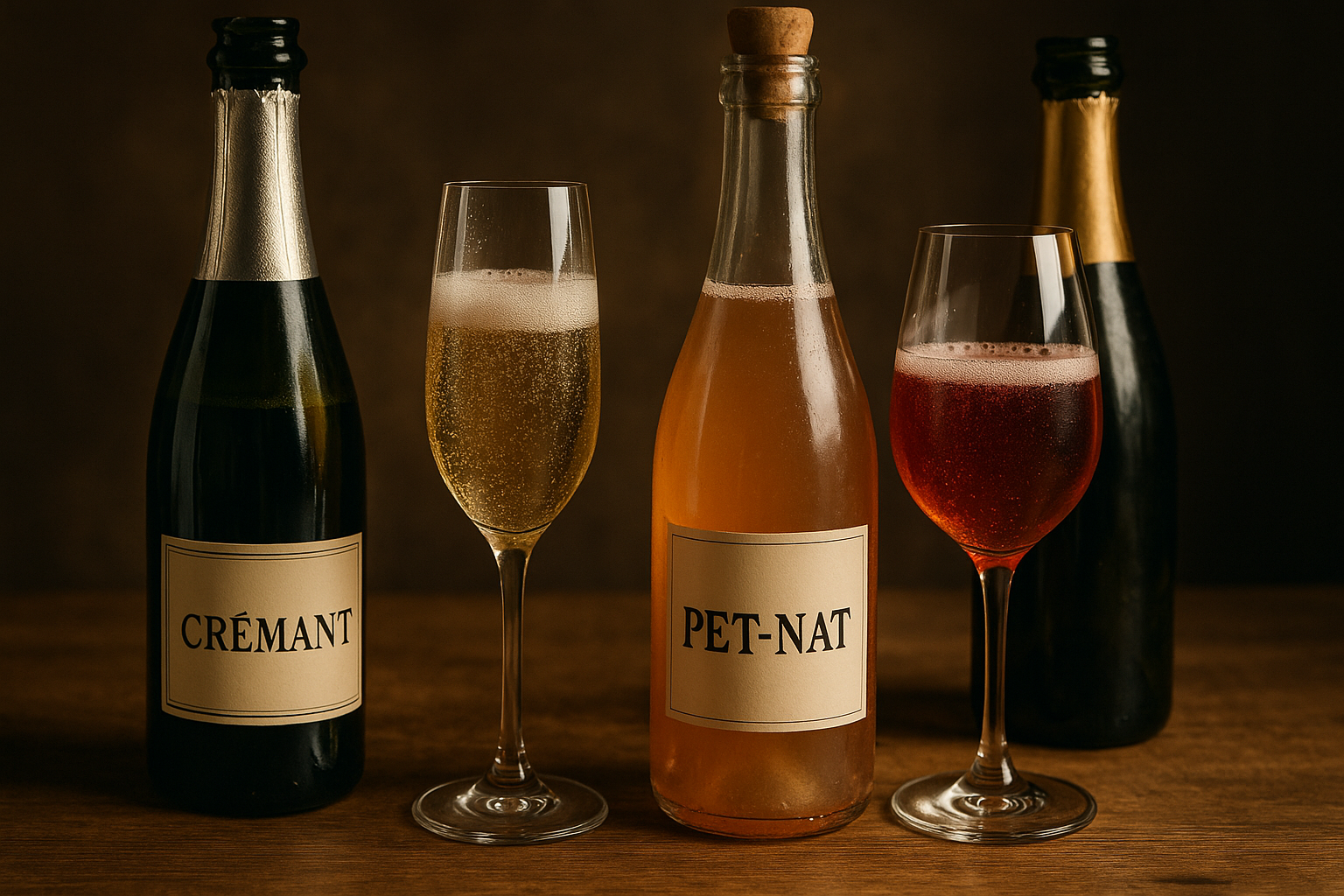
Why are French Crémant and Pet-Nat today drawing attention away from champagne and becoming favorites of sommeliers, wine bars, and curious connoisseurs?
Sparkling wines have long ceased to be associated only with champagne. In the world of professional sommeliers, wine bars, and curious wine lovers, other French names are increasingly heard — Crémant and Pet-Nat. They offer a different perspective on sparkling wine: more democratic in price, bolder in style, and closer to local traditions and "natural" winemaking.
What is Crémant: A Serious Alternative to Champagne
Crémant is a French sparkling wine produced using the traditional method (with a second fermentation in the bottle), but outside the Champagne region. It has AOC status, meaning it is strictly regulated by appellations (Cremant d’Alsace, de Loire, de Bourgogne, etc.).
Geography of Crémant: Eight Regions, Eight Characters
Unlike champagne, Crémant is not limited to one terroir. It is made in different parts of France, and each region gives the wine its own character:
- Crémant d’Alsace — bright fruitiness, aroma, often involving Riesling and Pinot Blanc.
- Crémant de Bourgogne — more structured and complex, based on Chardonnay and Pinot Noir.
- Crémant de Loire — freshness and acidity, with Chenin Blanc as the key variety.
- There are also Crémant de Bordeaux, de Jura, de Savoie, de Limoux, de Die, and others.
Thanks to this geographical diversity, Crémant can be both a refined aperitif and a gastronomic wine to pair with seafood, poultry, or even Asian cuisine.
How Crémant is Made: The Traditional Method Without the Word “Champagne”
The production technology of Crémant almost copies the classic "méthode traditionnelle" used in Champagne:
- A still base wine is created from local varieties (Chardonnay, Pinot Noir, Chenin Blanc, Riesling, etc.).
- A liqueur de tirage (a mixture of yeast and sugar) is added, and the wine is bottled.
- A second fermentation occurs in the bottle, creating CO₂ bubbles.
- The bottles are aged on the lees for a minimum of 12 months, which imparts notes of yeasty pastry, creaminess, and texture.
- After riddling, the lees are removed (disgorgement), dosage is added (or not, for Brut Nature), and the bottle is sealed with a cork.
In Champagne, the minimum aging period is longer — at least 15 months, and the requirements for terroir and grape composition are even stricter. However, in terms of technology, Crémant and champagne are very close, making Crémant a logical alternative with a more friendly price.
Why Crémant is Trending Now
- Price/Quality Ratio: Crémant often offers a similar level of complexity and style as basic champagnes but at a significantly lower cost.
- Regionality: For sommeliers, it is a tool to showcase the terroir of Alsace, Loire, or Burgundy in a sparkling format.
- Style: From dry minimalist Brut Nature to more fruity and soft versions — Crémant is flexible in terms of gastronomy.
Pet-Nat: Natural Sparkling and the Aesthetic of "Natural" Wine
Pet-Nat (short for pétillant naturel) is sparkling wines made using the so-called ancestral method (méthode ancestrale). Unlike Crémant, the term Pet-Nat has no unified national or European regulation, it does not belong to AOC, and is often associated with natural winemaking.
The Essence of the Ancestral Method
Technologically, Pet-Nat is almost the opposite of the traditional method:
- The grape must begins primary fermentation in a tank.
- When the wine is not yet fully fermented (some sugar remains), it is bottled, where fermentation continues, and CO₂ is "locked" inside.
- The yeast lees are usually not removed: the wines remain cloudy, with a noticeable yeast component.
This method is considered one of the oldest ways to obtain sparkling wine, which disappeared after the triumph of "classical champagne," but was "revived" during the popularity of natural wines.
Style and Taste of Pet-Nat
Pet-Nat can be white, rosé, or red; there are no unified rules for varieties — each region uses its own local grape varieties. White grapes produce fresh, acidic, often citrusy wines, while red grapes produce more structured, berry-like, sometimes almost cider-fruity wines.
Key style features:
- Less predictable carbonation: sometimes very sparkling, sometimes barely fizzy — it's difficult to perfectly control the residual sugar at the time of bottling.
- Lees in the bottle: often — a noticeable yeast trail, slight cloudiness, "natural" visual appearance.
- Freshness and lightness: usually wines are intended for early consumption, without long aging.
Many Pet-Nats are released under a crown cap, like beer or lemonade, emphasizing the casual style and distancing it from the ceremonial image of champagne.
Why Pet-Nat Became Iconic
- Hipster Aesthetic: Pet-Nat has firmly occupied the shelves of natural wine bars, becoming a symbol of the "anti-formal" approach to sparkling wines.
- Minimal Intervention: often these are wines with minimal sulfur, without filtration, without "cosmetics," which appeals to fans of naturalness.
- Play, Not Ceremony: Pet-Nat is perceived as wine for parties, picnics, gastro-experiments, not just for wedding toasts.
Crémant vs Pet-Nat: Two Philosophies of Sparkling Wine
Although both categories are French sparkling wines outside of champagne, their approach to style and audience is different.
Key Differences
- Regulation: Crémant is strictly regulated AOC with requirements for varieties, aging, and technology. Pet-Nat is a concept without a national legal status, more of a stylistic direction.
- Method: Crémant is the traditional method with a second fermentation in the bottle after creating a dry base wine. Pet-Nat is the ancestral method, where the wine finishes fermenting in the bottle without a separate second fermentation.
- Style: Crémant is more predictable, clean, refined, with controlled pressure and dosage. Pet-Nat is "wild," expressive, often unfiltered, with lees and variable bubble levels.
- Image and Use: Crémant easily "replaces" champagne as an aperitif or wine for dishes. Pet-Nat is more associated with a casual format, natural wine tastings, gastro-experiments.
How to Choose and Pair
When to Choose Crémant
- If you need a classic, elegant image but without the budget for champagne (corporate events, weddings, official occasions).
- For gastronomic pairs: Crémant de Loire works wonderfully with oysters and goat cheeses; Crémant de Bourgogne — with white fish, salmon tartare, pâtés.
- When you want to showcase the terroir of France through sparkling wine, using familiar gastronomic frameworks.
When to Reach for Pet-Nat
- For wine bars and tastings, where the audience is set for experimentation and "natural" styles.
- With street food, fusion cuisine, fermented dishes, pizza, tapas — where acidity, fruit, and a bit of chaos are needed.
- When you want a lively, unconventional experience, not a "classic" sparkling image.
Prospects: French Sparkling Wines Beyond Champagne
The boom of Crémant and Pet-Nat is not a one-season trend but a reflection of deeper changes in wine culture. Crémant satisfies the demand for affordable quality and terroir in a classic key, while Pet-Nat responds to trends of naturalness, individuality, and informality in wine consumption.
For professional blogs, wine bars, and restaurants, these categories are an opportunity to tell the audience the story of French sparkling wine far beyond the borders of Champagne. And for the consumer — a chance to discover that bubbles can be not only "official" but also homely natural, fun, and very diverse in character.








Comments (0)
No comments yet. Be the first to comment!
Leave a Comment