

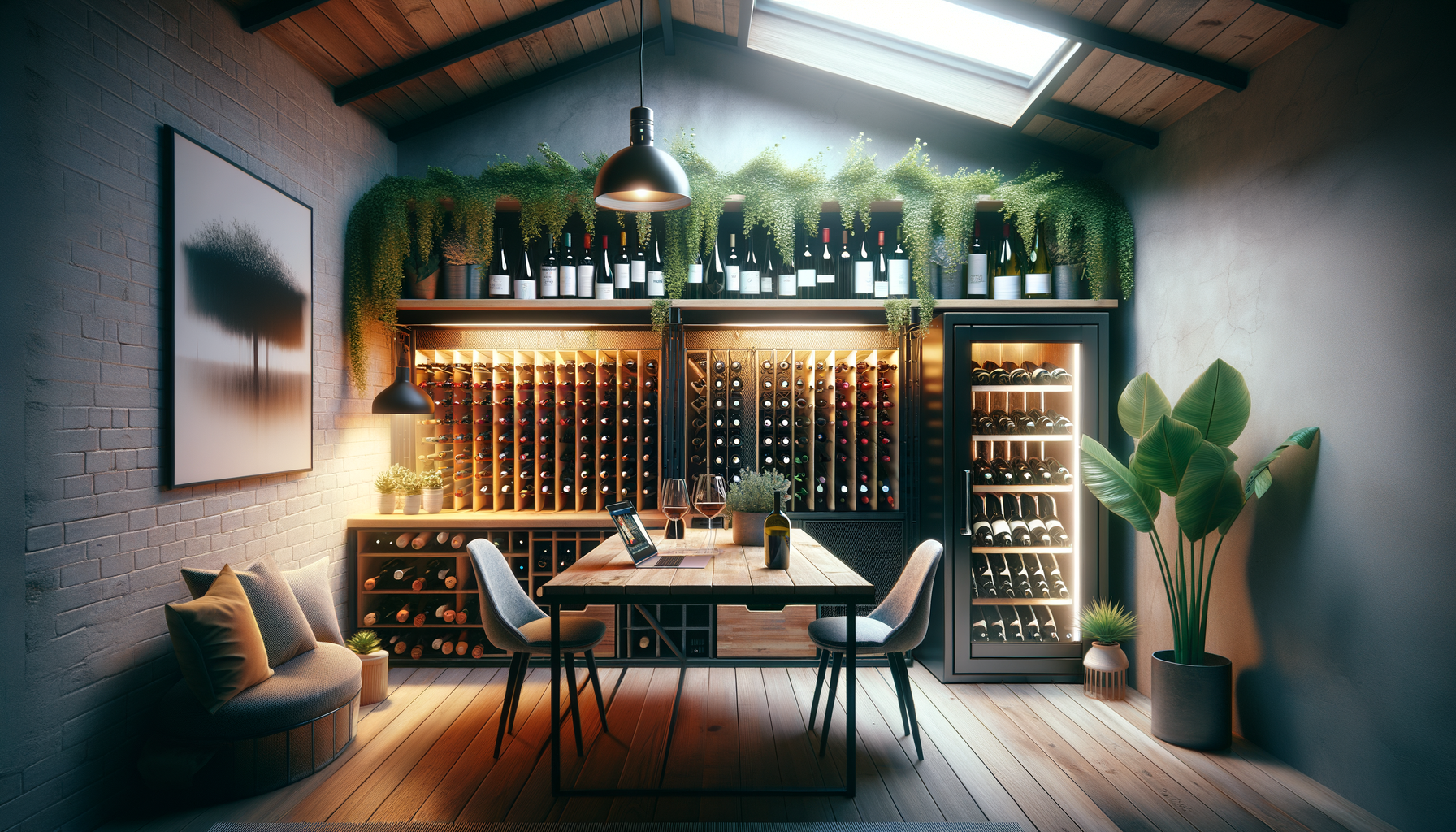
How to organize a "home cellar" in a regular apartment, preserve the taste of wine, and not spoil the bottles without a professional wine room.
Having a few favorite bottles at home is already a norm of city life. But there's a big difference between "keeping wine on a kitchen shelf" and "creating conditions for its aging." Most wines spoil not from time but from improper storage: heat, light, dry air, and vibrations quietly do their work. In a city apartment, there is no basement, but there are many solutions to organize your small "cellar" even in a closet or pantry.
Basic Conditions for Storing Wine at Home
To store wine properly, it's important to control four key factors: temperature, light, humidity, and bottle position. These determine whether the bottle will reveal its potential or turn into a disappointment.
Temperature: No Fluctuations and Overheating
Producers and sommeliers recommend storing wine within the range of 10–14°C as a universal range for aging most styles. For household storage in an apartment, a temperature range of 8–18°C is considered acceptable, but with minimal fluctuations. It is critically important to avoid overheating: at temperatures above 20–21°C, wine begins to age and spoil rapidly.
Approximate guidelines:
- Red wines: feel comfortable around 14–18°C;
- White and rosé: better stored cooler – 8–12°C;
- Fortified and dessert wines: mostly allow 14–16°C.
The biggest enemy is not so much inaccurate temperature as its sharp fluctuations: they change the properties of the cork, let air in, and the wine oxidizes and loses its taste.
Light: Wine Loves Darkness
Light, especially sunlight and ultraviolet, accelerates chemical reactions in wine and destroys aromatic compounds. Even artificial lighting (especially fluorescent lamps) can slowly spoil the drink. Therefore:
- avoid windowsills, open shelves, illuminated showcases;
- choose dark, closed places – cabinets, pantries, closed niches;
- if there is lighting, prefer incandescent lamps or warm LED with minimal ultraviolet.
Humidity: Balance Without Mold
The optimal humidity for storing wine is about 60–70%. Too low humidity dries out the natural cork, allowing air to penetrate the bottle, and the wine ages prematurely. Too high humidity promotes mold and label spoilage.
In an apartment, there is no point in fanatically measuring every percentage of humidity, but there are simple principles:
- do not store wine in the bathroom or near humidifiers;
- avoid places near radiators and heaters – the air is too dry there;
- for long-term storage in a cabinet, you can place a small container of water (if it's too dry) or use a wine cabinet with built-in humidity control.
Bottle Position: Stand or Lie?
For wines with a natural cork, the standard rule is to keep bottles lying down or at a slight angle so that the cork is constantly in contact with the wine and does not dry out. This is especially important if you plan to store the wine for several years.
There are exceptions:
- Sparkling wines (with wire corks) can be stored either standing or lying down – there is enough pressure and moisture inside the bottle to prevent the cork from drying out.
- Bottles with screw caps, glass, or metal corks are not afraid of vertical storage – they can be placed as convenient.
Where to Create a "Home Cellar" in an Apartment
In a city apartment, the main thing is to find a place that meets three requirements: dark, relatively cool, without sharp temperature fluctuations, and without vibrations.
Successful Options
- Pantry or storage room. Often the most temperature-stable place, protected from light. If necessary, a simple wine rack can be installed there.
- Closed cabinets in the hallway or room, away from external walls, radiators, and windows. The temperature there is usually more even than in the kitchen.
- Niches and drawers under the bed. Dark, quiet, no heat from the stove or appliances – a good option for household storage for up to a few years.
- Wine cabinet / wine fridge. This is the most convenient solution if you plan a small collection: temperature control (around 13°C), humidity, and protection from vibrations.
Where Not to Store Wine
- Kitchen. Frequent temperature fluctuations due to cooking, heat from the oven, stove, appliances, bright light – all this harms the wine.
- Regular refrigerator. It is too cold and has low humidity; it is not advisable to keep wine there permanently. Experts advise not to leave bottles in the kitchen refrigerator for more than a month, preferably only for a few hours before serving.
- Windowsills, open shelves, bar showcases with lighting. This solution is good for the interior but not for the quality of the wine: light and heat spoil the drink.
How Long Can Wine Be Stored at Home
Despite romantic stories about wines "for decades," experts emphasize: only about 1% of wines are created for long aging. More than 90% of bottles should be consumed within the first year after purchase or a few years from the harvest.
Approximate terms:
- Ordinary table wines – preferably consumed in the first 1–2 years.
- Most whites – 2–3 years if storage conditions are stable.
- Basic-level reds – 3–5 years if basic rules are followed.
- Homemade wine – on average 5–7 years, depending on technology and composition.
Most store-bought wines "for daily consumption" are made not for long aging but to bring pleasure today or in the coming years. Therefore, home aging in an apartment is more about careful storage than decade-long experiments.
How to Properly Store an Open Bottle
A common question for city life is what to do with an unfinished bottle. The key tasks: minimize contact with air and slow down oxidation.
- Immediately close the bottle – with its original cork, a vacuum stopper, or pour into a smaller container with a tight lid.
- Place in a cool place. The simplest is the refrigerator (preferably not on the door to avoid shaking).
Approximate storage times for open wine:
- Sparkling – up to 1 day;
- White and rosé – up to 3 days;
- Red – up to 5 days;
- Dessert and fortified – up to a week.
If you do not plan to finish the bottle, part of the wine can be frozen in ice cube trays and then used in sauces, stews, or for mulled wine.
Wine Cabinet or Improvised Cellar: What to Choose for a City Dweller
In an apartment, there are two main scenarios for storing wine.
1. Household Storage Without Special Equipment
This option is for those who keep a few dozen bottles at home for 1–5 years. Basic rules:
- temperature not above 20°C, without sharp fluctuations;
- dark place – cabinet, closed shelf, pantry, drawers under the bed;
- absence of high or too low humidity;
- horizontal storage of bottles with natural cork.
If these conditions are met, most everyday wines will calmly last 5–10 years, even if theoretically designed for a shorter period.
2. Wine Cabinet or Special Refrigerator
This option is logical if you:
- are collecting a small collection;
- buy wines with aging potential;
- live in an apartment with hot summers and unstable heating.
A wine cabinet maintains a stable temperature (around 13°C), optimal humidity, and protects from light and vibrations. It is essentially a compact substitute for a basement that easily fits into a modern interior.
Practical Checklist for Home Aging in an Apartment
- Choose wines that can realistically improve from a few years of calm storage – not all bottles are made for aging.
- Find the darkest and most temperature-stable place in the apartment – not in the kitchen and not near radiators.
- Store bottles with natural cork lying down; with screw or glass cork – as convenient.
- Do not keep wine for years in a regular refrigerator – use it only for cooling before serving.
- Immediately close an open bottle and place it in a cool place, focusing on storage times by wine style.
Home aging in a city apartment is not about perfect laboratory conditions, but about a reasonable compromise. A little attention to temperature, light, and bottle position – and your wine will live to the right moment just as the winemaker intended.







Comments (0)
No comments yet. Be the first to comment!
Leave a Comment