

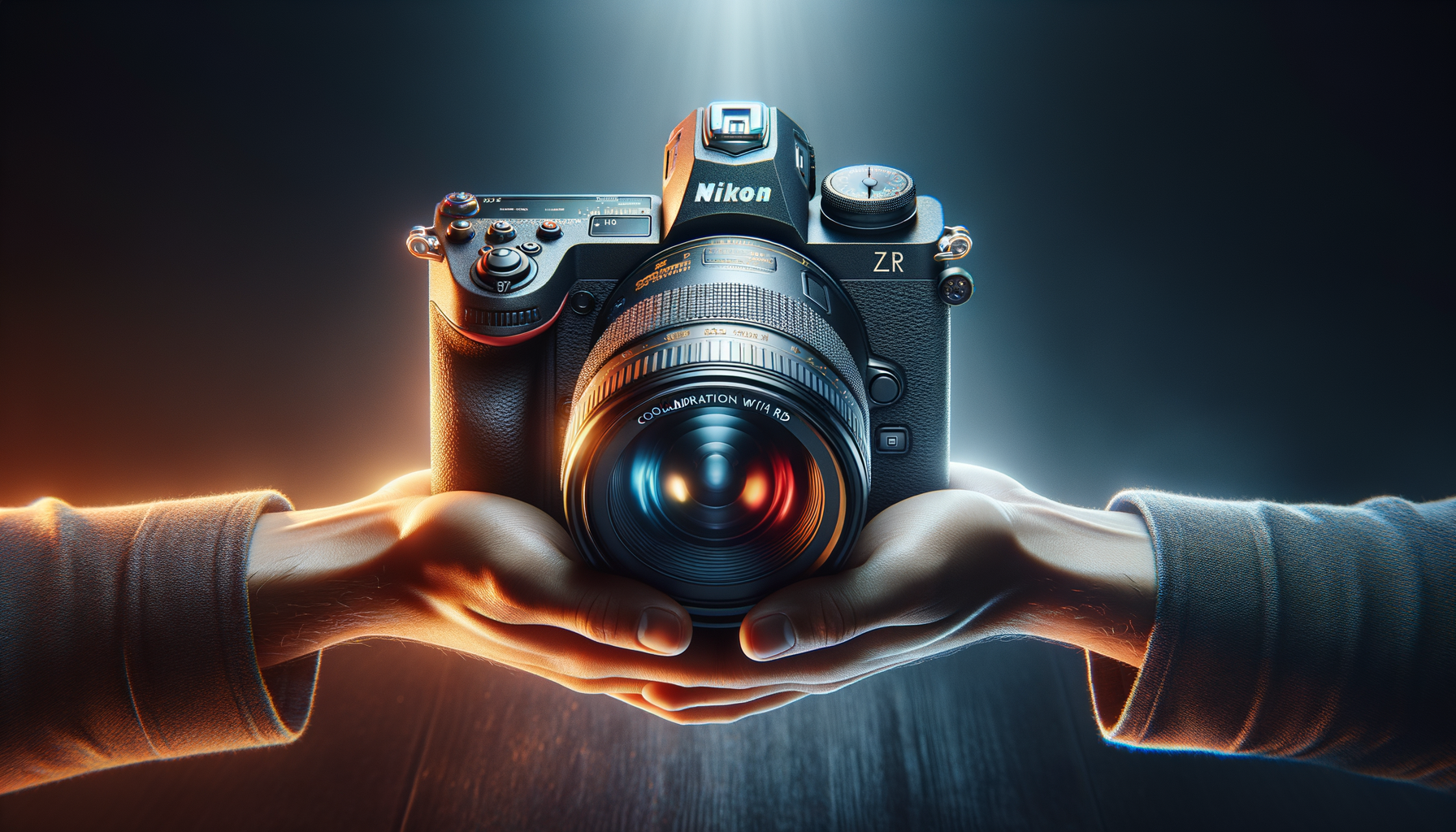
Reflections on Buying the Nikon Z R: What "Collaboration with RED" Really Offers, the Pros and Cons, and Who Really Needs This Camera and Who Doesn't.
At some point, every videographer reaches the dangerous thought: "I need a real cinema camera." And then the Nikon Z R appears on the horizon — a hybrid 6K camera made in collaboration with RED, supporting R3D (Nikon Edition) and RED Color Science.* On paper, it looks like a "junior RED for reasonable money" — the perfect solution to jump into the world of professional cinema. But if you take off the rose-colored glasses, it's not so straightforward.
What Nikon Z R is in practice
The Nikon Z R is built on the Nikon Z6 III base: the same full-frame 24.5 MP (partially multilayer) sensor, Z mount, hybrid autofocus, 5-axis stabilization up to ~7.5 stops, and dual base ISO 800 and 6400 for video.* The camera records video up to 6K 60p, 4K up to 120p, and Full HD up to 240p, features an electronic shutter, an enlarged 4" screen without a viewfinder, and a magnesium body with weather protection.*
Key point: it can write 12-bit RAW directly to the memory card in three formats — N‑RAW, ProRes RAW HQ, and the new R3D NE (Nikon Edition), which is the subject of all the debates.*
RED inside: what it really means
R3D NE and RED Color Science
Thanks to the collaboration with RED, the Nikon Z R receives:
- R3D NE codec — a simplified version of R3D with 12-bit depth, but with similar flexibility in post and the ability to change ISO and white balance after shooting;*
- RED Color Science — colorimetry algorithms that bring the image closer to the "RED look," plus creative modes and presets.*
Theoretically, this provides access to an ecosystem that was previously reserved for RED cameras: familiar color for colorists, predictable material behavior on the grade, and better integration into professional pipelines. In practice, however, there are several important "buts."
Limitations of R3D NE
Firstly, R3D NE is not a full 16-bit R3D but a 12-bit variant optimized for Nikon's hardware capabilities.* The dynamic range is claimed to be over 15 stops in the log profile, but the margin for gross exposure errors will be less than in top REDs with full R3D.
Secondly, for now, you can mostly work fully with R3D NE in RED Cine X Pro, and support by other NLEs will gradually expand.* If you edit in a studio with flexible software — no problem. But if you're a freelancer on a weak laptop — that's another issue.
Arguments "for" buying the Nikon Z R
1. Entry ticket into the world of filmmaking
The Nikon Z R combines:
- 6K 60p in RAW (R3D NE, N‑RAW, ProRes RAW HQ) on a CFexpress Type‑B card;*
- serious dynamic range and dual base ISO for working in challenging light;*
- a full-frame sensor with good stabilization for handheld shooting.*
For a relatively reasonable price, it offers functionality that was recently only characteristic of cinema systems like RED or ARRI (albeit with important limitations). For small productions or studio owners, it's a real way to raise the technical bar without a five-year loan.
2. Compromise between cinema and still photography
Despite its focus on video, the Z R doesn't completely abandon photos: 24.5 MP, electronic shutter, up to 20 fps in RAW and up to 120 fps in JPEG, normal exposure modes, stabilization, and hybrid autofocus.* For simultaneously shooting posters, backstage, and video, this is more than enough.
3. Form factor for stabilizers and rigs
Unlike classic cameras, Nikon removed the massive grip and viewfinder, making the body more "cinematic" — convenient for mounts, steadicams, cars, and rigs.* It's a small thing, but on a shooting day, ergonomics often matter more than an extra stop of dynamic range.
4. Audio and practical details
ZR supports 32-bit floating audio recording and spatial sound (Nokia OZO Audio), has the ability to power via USB‑C during shooting, allowing you to shoot until the memory cards are full.* For small teams where sound isn't always recorded separately on a recorder, this is a bonus.
Arguments "against" (or where marketing hides)
1. It's not a full-fledged RED camera
The presence of R3D NE and RED Color Science doesn't make the Nikon Z R a RED camera. It doesn't provide access to the full stack of proprietary technologies, color depths, sensors, and modularity characteristic of classic REDs. It's primarily a Nikon camera with licensed RED technologies, not the other way around.
If your motivation is to "have a RED for pennies," you should slow down. You're getting a hybrid camera with elements of the RED ecosystem, not a replacement for Komodo or V-RAPTOR.
2. Pipeline: harder than it seems
R3D NE and RAW output are not just "wow-quality," but also:
- heavy files that quickly fill CFexpress and disks;
- increased requirements for editing stations (CPU, GPU, storage);
- preferably — familiarity with RED Cine X Pro and understanding of log-flow and LUTs.*
If you're still editing H.264/H.265 on an average laptop, switching to R3D NE might turn editing into torture. In this sense, the camera easily outpaces your existing pipeline.
3. Do you really need 6K and R3D?
An honest question to ask yourself before buying: do your projects really need 6K RAW and R3D NE? Most commercial tasks — advertising, YouTube, corporate videos, even many festival shorts — comfortably live on 4K 10-bit Log with a good codec.
If the final output is 4K or even Full HD, and the budget for lighting, decorations, and the team is limited, investing in a more "cinematic" camera body might yield less quality improvement than investing in optics, sound, or lighting.
4. Lack of viewfinder and purely video orientation
For some, a "clean" body without an EVF is a plus, for others — a painful loss. The Nikon Z R is not considered a universal camera "for all occasions." You can shoot photos, but it's a side function, not the main one. If you're used to hybrid Z6/Z7 or cameras from other brands, the transition might seem like a step towards narrow specialization.
The battle with RED: mythology versus reality
The collaboration between Nikon and RED is a loud event, especially considering how RED previously guarded its codecs and patents. Now we have a situation where part of the "RED magic" has officially moved into a mass brand camera. This creates several expectations for potential owners.
What it really gives to a new owner
- Prestige and marketing plus. For clients, it sounds convincing: "shooting in R3D, RED technologies."
- Better perception among colorists. RED Color Science and R3D NE are familiar to many professionals, simplifying collaboration.
- Potentially better resale value. A camera with a "RED" aura might depreciate more slowly, at least while the hype is alive.
But there's also a downside.
- Overestimated expectations. The Nikon Z R won't make a project look like a Netflix original just because of the RED logo in the press release.
- Danger of tech fetishism. There's a risk of spending money on the camera body instead of improving the actual production quality (lighting, setup, team).
- Evolution, not revolution. It's a strong step for Nikon, but not the endgame for other brands. Competitors won't stand aside.
Who the Nikon Z R really makes sense for
- Small productions and directors who already shoot in Log/RAW, have knowledgeable colorists, and want access to an R3D-like pipeline without buying a full RED system.
- Operators working on mounts and rigs who need a lightweight, protected, and convenient body for cinema-oriented configurations.
- Those already in the Nikon Z system who want an upgrade to a cinema-oriented solution without changing their lens park.
Who should think twice:
- Beginners who haven't yet maximized 4K 10-bit cameras and haven't built a stable post-production pipeline.
- Wedding and event videographers for whom reliability, autofocus, autonomy, and quick editing often weigh more than 6K RAW and R3D.
- Those expecting a "cheap RED". The Nikon Z R is more of a "Nikon with RED technologies" than a "RED for pennies."
Skeptical conclusion for oneself, not for marketing
As a thought-provoking blog, this story about the Nikon Z R is not so much about the camera itself as it is about our expectations from technology. The Z R is indeed interesting: 6K, R3D NE, RED Color Science, dual base ISO, good stabilization, and a form factor for cinema — all this makes it a serious tool.
But the camera doesn't replace lighting, script, editing, and taste. If you clearly understand why you need R3D, how you will work with it, and who will pay for it — the Nikon Z R can be a logical step forward. If the motivation is simply "to have something with the RED logo in the description," perhaps it's worth updating your portfolio first, and then the camera.
*Specifications and capabilities mentioned are based on official and review information about the Nikon Z R and its collaboration with RED.








Comments (0)
No comments yet. Be the first to comment!
Leave a Comment