

A simple explanation of what KSeF is, when it will become mandatory, and what it means for an ordinary entrepreneur in Poland.
The National e-Invoice System, or KSeF for short, has been a topic of discussion among entrepreneurs, accountants, and officials for several months. It sounds intimidating, somewhat mysterious, and is associated with additional responsibilities. In reality, KSeF is simply a new way of sending and receiving invoices – entirely electronically, through a state-run IT system.
In this article, I will explain in simple terms what this system is, why it was introduced, when it will become mandatory, and what you should do to prepare for it calmly.
What is KSeF – in layman's terms
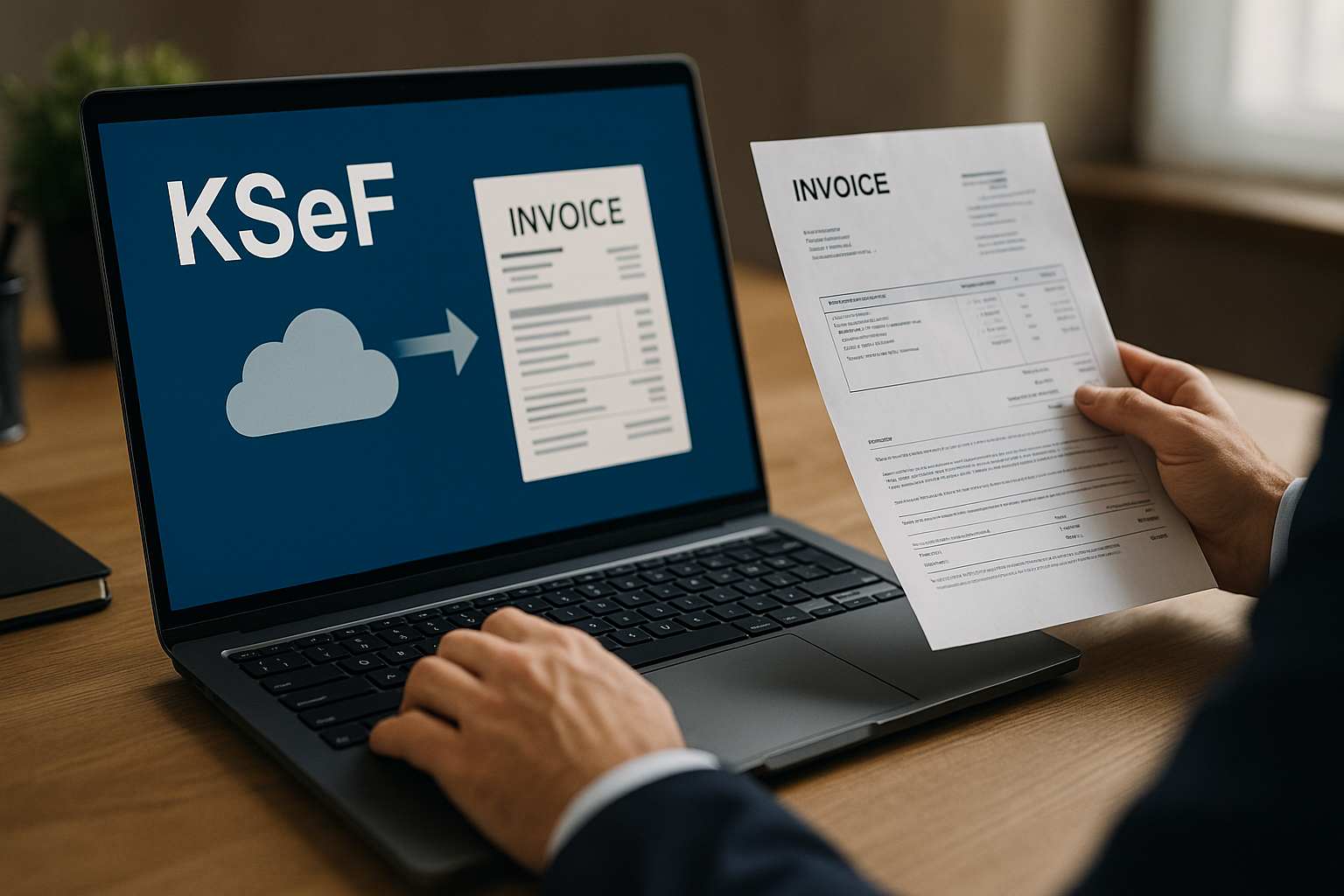
KSeF is a nationwide IT system prepared by the Ministry of Finance for issuing, sending, receiving, and storing invoices in a unified electronic form. Officially, this is called "structured invoices" – referring to invoices in a special XML format understood by accounting programs and the KSeF system.
What does this mean in practice?
- You issue an invoice in your invoicing program or in an application provided by the state,
- The program sends it to KSeF,
- The system checks if everything complies with the scheme, assigns a unique KSeF number to the invoice,
- The invoice is immediately delivered to the buyer through the system – no more sending PDFs by email or prints by mail.
Thanks to this, each invoice has the same data layout, making it easier to read in accounting and reducing the chance of errors.
When KSeF is mandatory and for whom
KSeF will be introduced in stages – the legislator decided that not everyone has to change their invoicing method at once.
Key dates
- February 1, 2026 – obligation to use KSeF for large companies whose sales (including VAT) in 2024 exceeded 200 million PLN.
- April 1, 2026 – obligation for other entrepreneurs and invoice issuers, except the smallest ones.
- January 1, 2027 – the smallest taxpayers, whose invoice sales do not exceed 10,000 PLN gross per month, can defer and start using KSeF only from this date.
Additionally, transitional provisions are planned until the end of 2026 – for example, it will be longer possible not to provide the KSeF number on transfers between VAT taxpayers, and offices are primarily expected to educate rather than immediately penalize for errors.
Should you be afraid of KSeF?
A new system always causes stress – that's natural. However, it's worth looking at KSeF without panic. For most entrepreneurs, it will simply be a change of tool for issuing invoices, not a revolution in the entire business.
Why KSeF is not so scary
- It's still a regular invoice – the form changes (from paper/PDF to electronic XML format), but the essence of the invoice remains the same: who, to whom, when, and for what was paid.
- The system is supposed to work like "mail" for invoices – you send the document to KSeF and are assured it will reach the contractor, and the state will have a copy. No more explaining that the invoice didn't arrive.
- Less paper and emails – you don't have to archive piles of binders, monitor shipments, prints, and signatures. The system archives invoices for you.
- Easier cooperation with the accountant – accounting can automatically download invoices from KSeF, less manual entry, fewer mistakes in numbers or amounts.
- Time to learn – the obligation is spread over time, and a transitional period and a more lenient approach to penalties are planned until the end of 2026.
Sure – you'll need to spend some time getting used to it. But if you already issue electronic invoices in an online program, switching to KSeF will mainly be a technical change of settings.
How KSeF works step by step
For simplicity, it can be described as follows:
- You issue an invoice in your invoicing program or in the Ministry of Finance application.
- The program automatically sends it to KSeF.
- KSeF checks if the invoice complies with the required template and assigns it a KSeF number.
- The invoice is then considered issued and delivered to the recipient – you no longer need to send it separately by email.
- The recipient has access to it through their program or the KSeF portal.
Access to the system can be obtained in several ways – for example, through a trusted signature, a qualified signature, a qualified seal, or a token associated with the company. Individuals running a sole proprietorship usually automatically have full rights, while companies must designate authorized persons, e.g., through the ZAW-FA form or electronic seal.
What is important for small businesses and freelancers
If you run a small business, a sole proprietorship, a blog, an online store, or provide services as a freelancer, KSeF will also apply to you. However, it's worth highlighting a few things:
- You have time – most smaller companies will enter KSeF only on April 1, 2026, and the smallest taxpayers only from January 1, 2027, if they meet the turnover condition of up to 10,000 PLN per month.
- You don't have to become an IT expert – providers of popular invoicing programs are already working on integration with KSeF. For you, the change should boil down to: "log in – enable KSeF support."
- You can use free tools – the state provides free applications for issuing invoices in KSeF, so even if you currently issue invoices in Word, you will have a simple tool to switch to.
- Easier control of your invoices – all are gathered in one system, they won't get lost in the email inbox or spam.
What to do now
You don't need to know all the technical details to prepare well for KSeF. A few simple steps are enough to avoid last-minute nerves.
1. Talk to your accountant or accounting office
- Ask how your office plans to work with KSeF.
- Determine which invoicing program you will use.
- Inquire if any authorizations are needed, e.g., ZAW-FA in the case of companies.
2. Check if your program will work with KSeF
- If you already use an online program, check its development plans – most providers already have the KSeF function planned or implemented.
- If you issue invoices "manually" (Word, Excel, paper), plan a switch to a simple program or free KSeF application.
3. Prepare access to e-services
- Make sure you have a working Trusted Profile or another electronic signature means, which will be useful for logging into the system or granting permissions.
- If you operate as a company, consider who will have the authority to issue invoices in KSeF.
Penalties and transitional period – what's the deal
The new regulations provide for sanctions for completely ignoring KSeF, but this does not mean that every mistake will result in a fine from day one of the system.
- The Ministry of Finance declares that initially, the focus will be on education and gradual implementation, not immediate penalties.
- A transitional period is planned until the end of 2026 – some obligations, such as entering the KSeF number on transfers between VAT taxpayers, will be deferred.
- The most important thing is not to pretend the issue doesn't exist – it's better to prepare calmly than to catch up quickly later.
Summary – KSeF for the ordinary entrepreneur
KSeF is not another invention just to make someone's life difficult. It's an attempt to organize the circulation of invoices in Poland – in one, common system. For the entrepreneur, this primarily means a different tool for issuing invoices and some learning at the start, but in the long run, it can simplify daily work: less paper, less chaos in emails, and simpler cooperation with accounting.
If you run a business, a blog, an online store, or work as a freelancer, you still have time to prepare calmly. Just talk to your accountant, check your invoicing program, and ensure access to e-services. The rest is mainly a matter of getting used to it – and as we know, that can be learned.





Comments (0)
No comments yet. Be the first to comment!
Leave a Comment